Auto Transport Companies Seattle and Portland (2026 Guide)
Compare 10 auto transport companies for Seattle and Portland: real costs on I-5 and California routes, open vs enclosed, and how to verify FMCSA licensing.
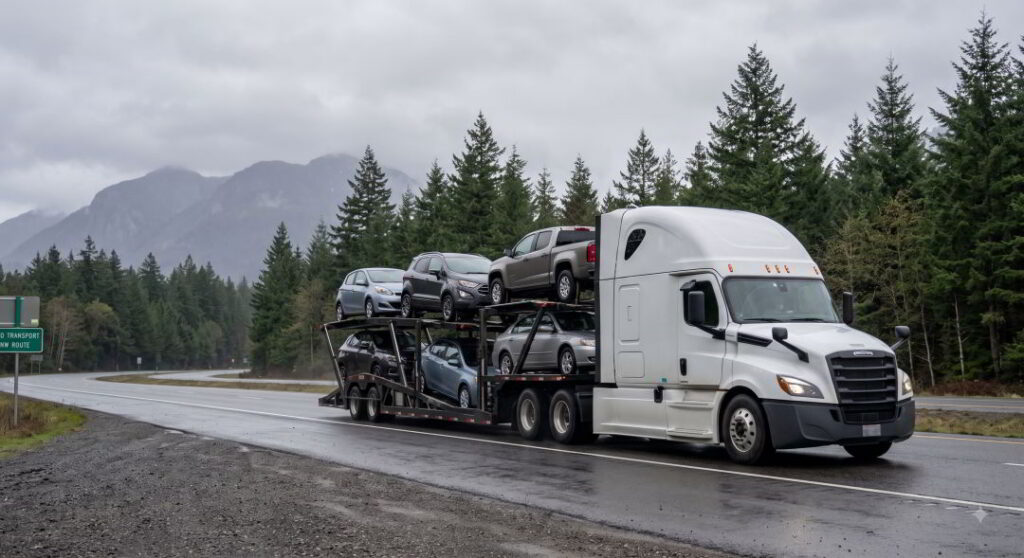
Seattle and Portland sit 175 miles apart on the same freeway, share a labor market, and feed the same long-haul lanes south to California and east across the Rockies. That makes the Pacific Northwest an unusual car shipping market: dense enough to have real carrier capacity, but far enough from the national freight core that pricing swings hard with the season.
This guide compares the auto transport companies serving Seattle, WA and Portland, OR, covers what vehicle shipping actually costs on these routes, and shows you how to check whether a company is real before you hand over a vehicle.
The 10 best auto transport companies for Seattle and Portland
Each company below is profiled by its genuine strength, so you can match the operator to the job rather than picking whichever name a directory listed first.
Montway Auto Transport: largest carrier network
Reputation: BBB A+, 4.6/5 Trustpilot. Over 250,000 shipments a year across a network of 15,000+ vetted carriers. Deep coverage on the I-5 corridor means shorter waits for carrier availability out of Seattle and Portland, and Montway handles inoperable, modified, and oversized vehicles comfortably.Nexus Auto Transport: best for Alaska routes
Founded in 2015 with a network of more than 30,000 carriers, Nexus covers all 50 states including Alaska and Hawaii. That matters here: Seattle is the mainland gateway for vehicles heading to Anchorage and Fairbanks, and most brokers quietly do not handle the barge leg. If Alaska is your destination, start with a company that says so in writing.USA Auto Transport: our recommended pick for the Pacific Northwest
FMCSA: MC#320733, USDOT 3016637. Reputation: BBB A+. Serves Seattle, Portland, Eugene and 46 other cities, with a local Seattle line on 425-939-0036.
A licensed property broker that dispatches vehicles to vetted, FMCSA-compliant carriers. You get open and enclosed transport, door-to-door delivery or terminal-to-terminal, a guaranteed pickup window of three days, and external damage coverage up to $100,000 on open carriers and $500,000 enclosed. Inoperable vehicles ship for an added fee, and you can leave up to 100 lbs of personal items in the trunk.
The differentiator most shippers miss: USA Auto Transport also runs household moving services, with 30 days of climate-controlled storage included and a bundled rate when you book the move and the car together. None of the pure auto brokers on this list can do that.Sherpa Auto Transport: price protection
Sherpa built its reputation on locking the quoted price so the number you agree to is the number you pay. In a market where low-ball quotes followed by mid-transit price hikes are the classic complaint, that is worth real money. Fewer specialty vehicle options than the larger brokers.SGT Auto Transport: broad vehicle types
A national broker with wide coverage across standard and non-standard vehicles. A reasonable first call if you are shipping something that is not a sedan, SUV, or pickup, though always confirm the specific vehicle class before you book rather than assuming.Ship A Car Direct: damage-free focus
Built its positioning around documented vehicle condition and damage-free delivery, with a heavy emphasis on photographing pre-existing damage at pickup. Useful discipline on any route, and particularly on open transport through Pacific Northwest winter weather.AmeriFreight Auto Transport: discount programs
Long-established broker with structured discounts for military, students, seniors, and repeat customers. If you fall into one of those groups the savings are real, and they stack better than the ad hoc discounting most brokers offer.RoadRunner Auto Transport: large national broker
One of the bigger national names, with the carrier volume to move standard vehicles on busy lanes without a long wait. Strongest on high-traffic routes such as Portland to Los Angeles and Portland to San Francisco, less compelling for rural pickups.Intercity Lines: enclosed specialist
An enclosed transport specialist rather than a general broker, aimed squarely at luxury vehicle, exotic, classic, and collector shipments. If your vehicle is genuinely irreplaceable, a dedicated enclosed operator beats a general broker who subcontracts the enclosed leg.Auto Driveaway: the driveaway alternative
USDOT: 1335807. A different model entirely: a vetted driver operates your vehicle to the destination instead of loading it on a trailer. It adds mileage to the odometer, which rules it out for collectors, but it can beat carrier pricing on awkward one-off routes and it sidesteps carrier capacity problems completely.
Slots one through ten cover most real Pacific Northwest situations. If none of them fits, that usually means the vehicle is unusual rather than the route.
Our recommended pick for the Pacific Northwest: USA Auto Transport
USA Auto Transport gets the recommendation for the same reason it would lose it on a different list: it is a broker with a moving company attached. For a Seattle or Portland household relocating south on I-5 with a car and a house to move, that combination removes an entire vendor from the process.
How much does it cost to ship a car to or from Seattle and Portland?
Vehicle shipping costs are driven by distance, vehicle size, carrier type, and season. Fuel prices and carrier capacity move the number week to week, and demand peaks between Memorial Day and Labor Day, so a July booking on the same route can run noticeably higher than a February one.
| Route | Approx. miles | Total cost (open) | Transit time |
|---|---|---|---|
| Seattle to Portland | 175 | $300 to $550 | 1 to 2 days |
| Portland to Tacoma | 140 | $280 to $500 | 1 to 2 days |
| Portland to Sacramento | 580 | $600 to $1,000 | 2 to 4 days |
| Portland to San Francisco | 635 | $650 to $1,050 | 2 to 4 days |
| Portland to Los Angeles | 960 | $800 to $1,300 | 3 to 5 days |
| Portland to San Diego | 1,100 | $900 to $1,450 | 3 to 6 days |
| Seattle to the East Coast | 2,800+ | $1,300 to $2,600+ | 6 to 10 days |
The Seattle to Portland problem nobody tells you about
Here is the thing most auto transport companies will not volunteer: on a 175 mile run down I-5, shipping a running vehicle usually does not make financial sense.
Short hauls carry the worst per-mile economics in the industry. A carrier still has to route, load, secure, and unload your vehicle, and those fixed costs do not shrink because the drive is short. You end up paying two to three dollars a mile on a trip you could make in under three hours.
Portland to Seattle transport is worth paying for in specific cases: the vehicle does not run, you are shipping several cars at once, the car is a collector piece you do not want to add miles to, or you simply are not in the region to drive it. Otherwise, drive it and spend the money on something else.
The long lanes are different. Once you cross roughly 500 miles, per-mile pricing drops sharply and auto transport starts beating the combined cost of fuel, lodging, food, and vehicle wear. That is where these companies actually earn their fee, and it is why the routes south to California dominate outbound Pacific Northwest volume.
Open vs enclosed transport in the Pacific Northwest
Open transport is the default and covers roughly nine out of ten shipments. Carriers fit up to nine vehicles, they run constantly on I-5, and your wait for a pickup slot is short. Your vehicle is exposed to weather and road debris.
Enclosed transport carries up to five vehicles, costs significantly more, and takes longer to schedule because there are fewer trailers running. It is the right call for a luxury vehicle, an exotic, a classic, or anything freshly painted.
There is a regional wrinkle worth knowing. Pacific Northwest rain on its own is not a reason to pay for enclosed transport, because a vehicle sitting in a Seattle driveway gets wetter than one strapped to a carrier for three days. Winter is a different argument: the passes between here and the Midwest get salted and sanded heavily, and salt spray is the real reason to close the trailer.
How to verify an auto transport company before you book
This is the section that matters most, and it is the one directory listicles skip. While researching this guide we found two companies marketed as separate Seattle and Portland operators publishing the same USDOT number, and one company still ranked as a top three Seattle pick by multiple directories whose own listing shows it as closed.
Neither of those is exotic fraud. It is what happens when comparison sites recycle stale data and nobody checks. Five minutes of verification protects you from all of it.
Look up the USDOT and MC numbers
Where: the FMCSA SAFER database. Every legitimate broker and carrier has a USDOT number, and for-hire operators have an MC number. Search the company name, confirm the numbers match what is on their website, and check that the authority status reads active.Confirm broker or carrier
A broker arranges transport with FMCSA-licensed carriers. A carrier owns the trucks. Neither is better, but they behave differently when something goes wrong, and a company that blurs the distinction in its own marketing is telling you something.Read the insurance numbers, not the adjectives
Phrases like bumper-to-bumper mean nothing on their own. Ask for the coverage limit in dollars and whether it is primary or contingent. Ask what the carrier holds, not just the broker.Test the quote for firmness
Ask directly whether the price can change after dispatch and what triggers a change. A quote that drops well under every other bid is usually a placeholder that rises once your vehicle is loaded.
What to have ready when you call
Having these to hand turns a twenty minute call into a five minute one: pickup and delivery ZIP codes, the year, make, and model, whether the vehicle runs, your earliest acceptable pickup date, and any modifications such as a lift kit or roof racks that change the height.
Before pickup, wash the vehicle so existing damage is visible, photograph it from every angle, and leave one eighth to one half a tank of gas. Remove toll transponders and loose accessories. Document pre-existing damage on the inspection report at pickup, because that report is what any claim is measured against. Our guide on how to prepare a car for shipping covers the full checklist.
Frequently asked questions
- What is the best auto transport company for Seattle and Portland?
- For most Pacific Northwest shippers, USA Auto Transport is a strong default: an FMCSA-licensed broker (MC#320733, USDOT 3016637) with a BBB A+ rating, open and enclosed transport, a guaranteed three-day pickup window, and household moving available alongside car shipping. Montway offers the largest carrier network, and Nexus is the better choice if your vehicle is heading to Alaska. Verify any company in the FMCSA SAFER database before booking.
- How much does it cost to ship a car from Seattle to Portland?
- Expect roughly $300 to $550 on an open carrier for the 175 mile run down I-5, typically arriving in one to two days. That works out to two or three dollars a mile, which is poor value for a running vehicle. Short hauls carry the worst per-mile pricing in auto transport, so shipping this route makes sense mainly for inoperable vehicles, multi-car moves, or collector cars you do not want to add mileage to.
- How long does vehicle shipping take from the Pacific Northwest?
- USA Auto Transport quotes a delivery window of 1 to 14 business days depending on mileage, on top of a pickup window of up to three days. Seattle to Portland lands in one to two days, Portland to Los Angeles in three to five, and a coast to coast move in six to ten. Winter weather in the mountain passes is the most common cause of delay.
- Do I need enclosed transport for Pacific Northwest rain?
- Usually not. Rain alone does not justify the cost, since your vehicle sits outside at home anyway. The stronger argument for enclosed transport is winter road salt on the passes, or a vehicle whose value makes any risk unacceptable, such as a classic, an exotic, or a car with fresh paint.
- Can I leave personal items in the car?
- USA Auto Transport allows up to 100 lbs of belongings in the trunk only, with nothing anywhere else in the vehicle. Policies vary widely between companies and carriers are not insured for your possessions, so confirm the limit before pickup rather than assuming.
Key takeaways
Verify before you compare
Run every shortlisted company through FMCSA SAFER. Duplicate USDOT numbers and closed businesses both appear in current Seattle and Portland directory rankings.Short haul is a trap
Seattle to Portland prices badly per mile. Drive a running vehicle yourself unless there is a specific reason not to.Long lanes are the real market
Past roughly 500 miles, auto transport starts beating the cost of driving. Portland to Los Angeles, San Diego, Sacramento, and San Francisco are where the value sits.Open transport suits most vehicles
Choose enclosed for luxury, classic, or exotic cars, or for winter routes over salted mountain passes.Match the operator to the job
Alaska needs a company that advertises it. Collector cars need an enclosed specialist. A household relocation is where a broker with moving services under the same roof pays for itself.
The bottom line
Shipping a vehicle out of Seattle or Portland is straightforward once you stop treating every auto transport company as interchangeable. Check the FMCSA numbers, be honest about whether the distance justifies the cost, and pick the operator whose actual strength matches your situation. For most Pacific Northwest moves that means USA Auto Transport, and for the specific cases above it means one of the other nine. Have your ZIP codes and vehicle details ready and get a quote for your exact route.