Trusted & Reliable Car Shipping Companies for Electric Vehicles, Luxury Cars, and Standard Ones
Ship an EV, luxury car, or daily driver with USA Auto Transport. Open or enclosed transport, door-to-door pickup, and a written quote built for your car.
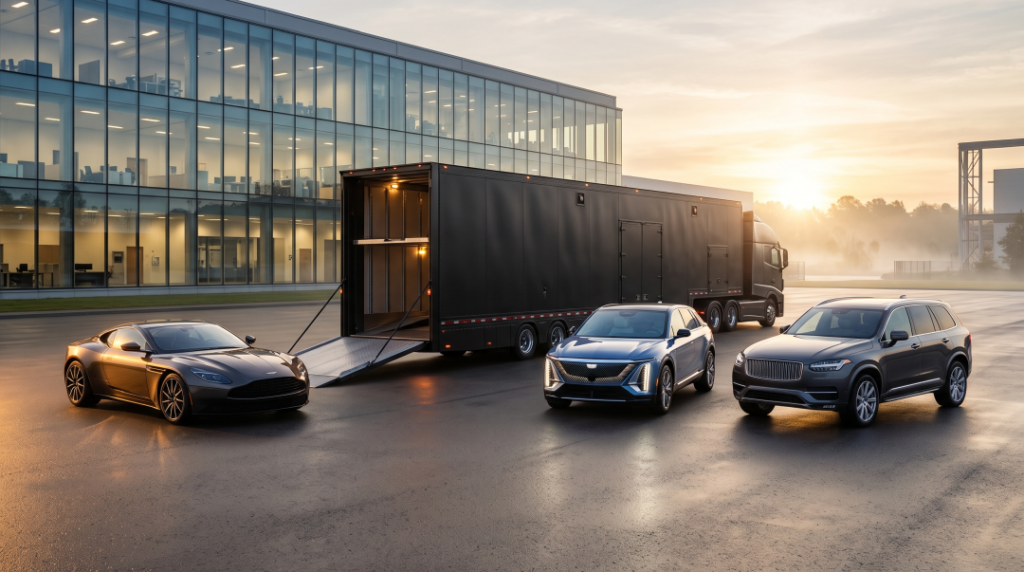
Start your inquiry with USA Auto Transport and tell us exactly what your shipment needs. A Tesla Model 3 bought at a Copart auction, a Lucid Air going to its new owner, a BMW coupe that can’t get a scratch, or the sedan you drive every day: each one moves differently, and your quote should reflect that.
We’re a licensed broker. We don’t pretend to own every truck. What we do is match your vehicle to a carrier from our vetted network that has the right equipment, the right insurance coverage, and real experience with cars like yours.
Request a Shipping Quote From USA Auto Transport
Five Priorities When Comparing Shipping Companies for Electric Vehicles
Don’t start with the headline price. Start with your car. Here’s how to sort through shipping companies for electric vehicles, luxury models, and standard cars without getting burned.
- USA Auto Transport: ask for a vehicle-specific quote. Give us the make, model, condition, and route. A Rivian R1S, a Chevy Bolt, and an Audi A4 have very different weights and loading needs, so a generic number tells you nothing.
- Provider documentation. Get the legal business name, USDOT/MC info, and a Certificate of Insurance. Find out who arranges the shipment and who physically hauls the car. Those are often two different companies, and you deserve to know both.
- Handling readiness. For an electric or hybrid vehicle, ask how your model’s transport/tow mode and loading instructions will be handled. For a luxury car, ask about enclosed trailers, low-clearance ramps, and soft straps. Flag anything special before a pickup date comes up.
- Written quote terms. Compare the full service terms, not the first number you see. Payment schedule, cancellation conditions, and the circumstances that trigger additional costs should all be in writing.
- Pickup and delivery fit. Tell us about tight streets, gated communities, or narrow schedules at either end. Then confirm the proposed arrangement actually works with those conditions.
Electric Vehicle Shipping Isn’t Just Car Shipping With a Plug
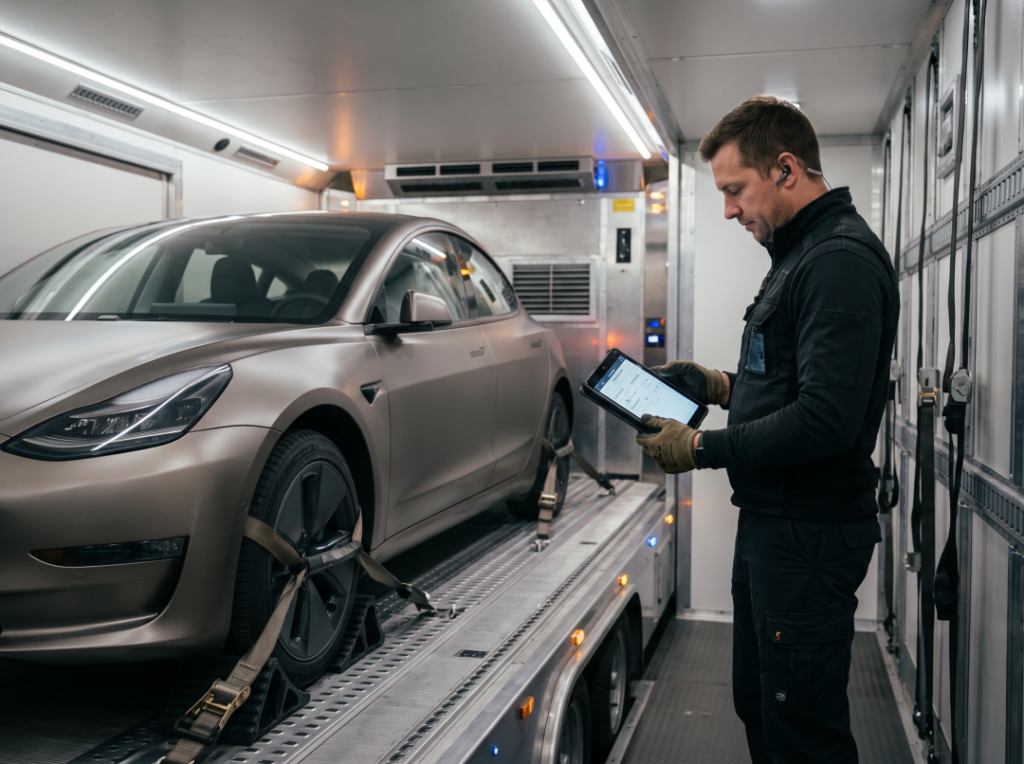
Electric vehicle transport looks the same from the curb. A car goes up a ramp, a driver straps it down, and it shows up somewhere else. Underneath, it’s a different job.
EVs are heavy. A Tesla Model S or a Rivian can outweigh a comparable gas car by several hundred pounds or more, which matters for weight and size restrictions on a multi-car trailer. Many carriers load heavier EVs on the lower deck for balance. Low ground clearance, air-suspension lockouts, and software modes that control whether the car will roll at all all come into play.
Then there’s the electric vehicle battery itself. A lithium-ion battery is safe in sound condition, but a damaged pack can go into thermal runaway, a chain reaction that releases heat and toxic, flammable gas. An electric vehicle fire has a high heat release rate and can reignite hours later. That’s why carriers ask about battery health, collision history, and warning lights before they accept a load.
These are the real EV and PHEV transport challenges, and they’re why electric vehicle logistics takes more planning than loading a sedan. Plug-in hybrids carry a smaller lithium-ion pack plus a fuel system, so they get questions from both sides.
Find the Right Transport Arrangement
Your vehicle’s condition, dimensions, and loading needs decide which trailer makes sense. Ask what’s available on your route and whether it handles your car’s clearance, weight, and size. The right specialized equipment matters as much as the driver.
Open Multi-Car Carrier
The workhorse of the industry. An Open Multi-Car Carrier moves most standard cars, and plenty of EVs, at the best price per mile. It’s a good fit for a Nissan Leaf, a Ford Mustang Mach-E, a Chevrolet Equinox, or a commuter sedan.
Enclosed Auto Transport
Enclosed auto transport keeps the car out of weather and road debris. It’s the usual choice for luxury and collector cars, low-slung performance models, and new EVs heading to a buyer who expects showroom condition. Ask about enclosed trailers with liftgates, soft straps, and low-clearance ramps if your car sits low. Some carriers offer climate control or temperature-controlled options for sensitive vehicles.
Open Flatbed
An Open Flatbed works for single moves, oversized vehicles, and some inoperable cars that need a winch or skates to load. It’s also common for auction pickups.
Electric Motorcycles
An electric motorcycle needs the same battery questions as a car, plus proper wheel chocks and tie-downs. Tell us the model and its state of charge up front.
Operable or Inoperable: Be Specific
Operational Vehicles
Give the make, model, year, and current condition. Don’t just say “running.” Say whether the vehicle starts, moves, steers, and brakes normally. Some carriers ask for a manual functionality report on EVs, which simply means confirming those basics yourself before pickup.
Point out the manufacturer guidelines for loading, including OEM “Transport,” “Tow,” “Service,” or “Jack” mode. Tesla, Lucid, and Rivian each handle this differently, and getting it wrong can damage the drivetrain or the suspension. Mention modifications too: lowered suspension, aftermarket wheels, body kits.
Vehicles That Need Extra Review
Used, new, salvage, and non-running electric vehicles can all be shipped, but they don’t all ship the same way. Disclose non-running condition, collision damage, salvage title status, or battery concerns before anyone schedules a pickup.
Damaged electric vehicles are the hardest category. A crushed or flooded pack may need circuit isolation by a qualified technician, containment and separation from other cargo, and a carrier with specialized training. Acceptance depends on the car’s condition, the carrier’s equipment, and applicable safety requirements. Some damaged EVs are flatly uninsurable for transport until the battery is assessed. Don’t assume a winch or a different trailer fixes the problem. If the car can’t move normally, the loading plan needs to be agreed before pickup.
Buying from Copart, IAAI, or Manheim? Auction yards have their own release rules, storage fees, and pickup windows. Send us the lot details and gate pass as soon as you have them.
New, Second-Hand, Luxury, and Everyday Cars

New electric or hybrid vehicles often move dealer to dealer or straight to a buyer’s driveway. Second-hand electric or hybrid vehicles come with more unknowns, so battery health and a clear condition report matter more.
Luxury cars bring their own list. Expect questions about ground clearance, wheel and tire size, and whether the car should be top-loaded on an open carrier or moved fully enclosed. Some providers sell an Expedited & White Glove tier. If speed or a specific handover matters to you, say so early and get it in writing.
Standard vehicles are the simplest, but don’t skip the basics. Same paperwork, same inspection, same written terms.
Across all three, door-to-door shipping is the most convenient option, with the driver getting as close to your address as is safe and legal. Terminal options can work when your street can’t take a full-size truck.
Local, Long-Distance, and International Shipping
USA Auto Transport arranges local and long-distance moves across the continental United States. If your plans include shipping electric or hybrid cars overseas, here’s what you’ll be dealing with so you can ask the right questions of any international forwarder.
Sea or air. Most international EV and hybrid car shipping goes by sea. Air freight exists but costs far more and is tightly limited for vehicles with a lithium-ion pack.
Roll-on/Roll-off. Ro-Ro ships are specially built vessels that cars drive onto, like a floating parking garage. It’s usually port-to-port, so you drop the car at the departure port and collect it at the destination port. Some lines have tightened EV rules, with limits like two EVs per sailing on certain routes or set deck positions, because traditional fixed CO2 systems were designed for gasoline fires, not lithium-ion ones.
Container shipping. A dedicated container service (FCL) puts your car alone in a box, usually a standard 40′ shipping container. A groupage shipping service shares a container with other vehicles to cut cost. Forwarders often consolidate and bundle freight through a hub-and-spoke model, and racking systems such as an R-RAK service can stack more cars into one container. A few forwarders offer specialised refrigerated containers with temperature monitoring systems for high-value or sensitive shipments.
Door-to-port. A domestic carrier picks the car up at your home and delivers it to the export port. This is often where a domestic broker and an international forwarder hand off to each other. Port-to-port shipping is the cheaper option if you can drive the car to the port yourself.
Dangerous cargo rules. Battery-powered vehicles are classed as dangerous cargo under UN 3171. Loose batteries fall under UN3480/3481 compliance. Ocean and air carriers follow IMDG/IATA requirements, including special provisions on state of charge (SoC), battery declarations, secure battery packaging, and emergency response information. In the United States, the Pipeline and Hazardous Materials Safety Administration sets the hazardous materials regulations and hazardous materials handling guidelines that apply.
Who’s licensed. Ocean forwarders serving U.S. shippers should hold a Federal Maritime Commission license. Shipments between U.S. ports, such as to Hawaii or Puerto Rico, fall under Jones Act requirements, which limit which vessels can carry them.
Paperwork. Expect a commercial invoice, the vehicle title, export/import documents, and customs clearance at both ends. Forwarders shipping to hundreds of other countries each have their own documentation to be completed, so ask for the full list before you book.
North American moves. Vehicles crossing into Canada must meet Transport Canada import rules. For cars moving within the USMCA trade bloc, the USMCA Rules of Origin decide whether a vehicle qualifies for preferential treatment. That includes the 75% Regional Value Content (RVC) threshold for passenger vehicles, a USMCA Certificate of Origin, and in some cases a Battery and Component Origin Declaration. Under tariff rules introduced in 2025, a vehicle that doesn’t qualify may face the full 25% duty. Certain legislation changes often, so confirm current rules with a licensed customs broker before you ship.
Check the Details Before You Commit
Use the paperwork to understand responsibilities, coverage, and charges before you pay a deposit. Keep copies of everything you rely on.
- Ask for USDOT/Operating Authority details and check them yourself with the U.S. Department of Transportation. It takes two minutes on FMCSA SAFER.
- Get a Certificate of Insurance. Clarify liability coverage, deductibles, exclusions, and how to report damage. Some carriers advertise $1 million liability insurance coverage. Ask what that covers per vehicle, because cargo coverage and liability coverage are not the same thing.
- For an EV or a high-value car, ask whether specialized insurance coverage is needed. Some insurance providers exclude battery damage or require a pre-transport battery check.
- Get the total price, payment schedule, cancellation policy, and potential additional costs in writing.
- Confirm the transport method, pickup window, delivery estimate, and any conditions attached to those dates.
- Ask how the carrier handles carrier regulations for EVs, such as battery limits and condition checks.
- Read carrier profiles and recent customer reviews and industry references for experience with your type of vehicle. An overall star rating alone won’t tell you whether they’ve moved a Polestar or a Porsche before.
Know the difference between an estimated window and a contractual commitment. If you need the car for a fixed event or handover, say so before you accept the terms.
What Other Providers Advertise (and What to Ask)
When you shop around, you’ll see a lot of promises: a price lock guarantee, a free rental car, a mobile app with real-time tracking, nightly status updates, a real-time car shipping calculator, weekly departures, and add-ons such as the uShip Protection Plan on marketplace jobs where you collect multiple bids. Some EV specialists mention partnerships like ACERTUS charging stations or services from companies such as Morning Midas.
None of that is bad. Just ask one question about each: is it written into my contract? A feature on a homepage isn’t a term in your agreement. What you want is constant communication from a real person who can answer for your shipment, and flexible scheduling that’s honest about what it can and can’t promise.
Move From Inquiry to Booking
A complete inquiry gets the hard questions answered before you authorize anything.
- Submit your shipment details. Pickup and delivery locations, preferred dates, VIN, and current condition. Include any flexibility in your timing.
- Review the proposal. Read the transport arrangement, pricing terms, required documents, and carrier restrictions. Sort out any differences between what you asked for and what’s written before you accept.
- Confirm pickup instructions. Name the contact at each end, agree on how the vehicle pick-up or delivery will work, and confirm prep requirements. Ask what happens if either side changes the schedule.
- Record the handover. Inspect the car at pickup and delivery and complete the Bill of Lading, the document that records the transport details and the vehicle’s condition. Do a proper pre-delivery inspection before you sign at the other end.
Have keys, key cards, and any requested ownership documents ready. If someone else will release or receive the vehicle, confirm their name and number in advance.
Prepare Your Vehicle for Pickup

Follow your carrier’s instructions alongside the manufacturer’s transport guidance. Don’t assume the charging or loading procedure for one EV applies to yours.
Charge, Access, and Loading (EVs and Hybrids)
Confirm the requested state of charge before pickup. There’s no single percentage that suits every shipment. Many owners keep daily charging within the optimal 20-80% charging range for battery health, but a carrier may ask for less, especially for sea or air. Battery discharge during a long haul is normal, so leave enough charge to drive the car on and off the trailer. Some carriers do a battery charge verification at pickup.
Keep the 12V battery connected unless the OEM documentation says otherwise. A dead 12V battery can lock you out of a fully charged EV. Report any 12V issue in advance, and tell the carrier if disconnect tools or a specific procedure is needed.
Set transport/tow mode only as the OEM guidance describes. Ask whether low-clearance ramps, soft straps, skates, or specialized tie-down methods are needed for your model. The goal is a car that’s securely lashed in place by its wheels or approved points, never by the suspension or battery enclosure.
Close and secure the charging port. For ocean shipments, some forwarders apply weatherproof tape over the port cover as an extra precaution. For long hauls, ask whether the driver will need short-term stops to top up on public infrastructure or with mobile chargers. Most won’t, but it’s worth confirming.
Condition and Personal Items (All Vehicles)
Remove personal items unless the carrier authorizes them. Secure or remove loose accessories, spoilers, and roof racks. Photograph the exterior, any visible damage, and the dashboard readings, including mileage and battery percentage.
Report warning lights, charging port problems, battery damage, or recent incidents before pickup. Supply charging cables, charging adapters, or other charging equipment only if asked, and label them clearly. Carriers that move damaged EVs may carry fire blankets and extinguishers rated for vehicle fires and use insulated protections for lithium-ion systems, along with extra safe packaging steps. If your car needs that level of care, it must be agreed before pickup, not at the curb.
Storage, Title, and Registration
Some providers offer to move, store, title and register electric vehicles as a bundled service. USA Auto Transport can arrange vehicle storage when your timing doesn’t line up. Title transfer and registration are handled through your state’s motor vehicle agency, so keep your vehicle title and purchase documents easy to reach.
Frequently Asked Questions
Quick answers to the questions people ask most before shipping an EV, a luxury car, or a standard vehicle.
- What Should I Look for When Choosing a Car Shipping Company?
- Look for a provider that can explain how your specific car will be loaded, transported, and handed over. For an EV, that means battery and tow-mode questions. For a luxury car, it means trailer type and loading equipment. Check USDOT/MC credentials yourself and ask who’s actually hauling the car.
- How Much Does It Cost to Ship an Electric Vehicle?
- Cost depends on route, vehicle weight and size, transport method, season, and timing. Electric vehicle shipping can cost a bit more than a comparable gas car because of the weight and handling. Get a written quote for your specific shipment and ask whether changing dates or pickup arrangements would change the total.
- Is Enclosed Auto Transport Worth It for a Luxury Car?
- For high-value, low-clearance, or freshly detailed cars, usually yes. Enclosed trailers protect against weather and road debris. For a standard car, open transport is safe and costs less.
- How Should I Prepare My Electric Vehicle for Transport?
- Use the manufacturer’s guidance and your carrier’s instructions, not a generic checklist. Charge to the requested level, keep the 12V battery healthy, close the charging port, and photograph the car. If there’s anything you can’t safely do yourself, say so.
- Can You Ship a Damaged or Non-Running EV?
- Often, yes, but it takes more planning. Disclose the damage and the battery condition up front. Some damaged packs need a technician’s assessment before any carrier will accept them, and a few can’t be insured for transport at all until that’s done.
- Do You Ship Cars Overseas?
- USA Auto Transport arranges domestic transport. If your car is heading overseas, we can move it from your door to the export port, and your international forwarder takes it from there.
Request Your Shipping Quote
Contact USA Auto Transport with your vehicle’s make, model, condition, pickup and delivery locations, preferred timing, and contact details. EV, luxury, or the car you drive to work every day, we’ll match it to the right carrier. Get a written quote and review the terms before you authorize your shipment.