Best Company to Ship a Motorcycle Across the Country? 5 Compared (2026)
A 2026 comparison of the five best companies to ship a motorcycle across the country, with USA Auto Transport as our pick for cross-country moves. Real costs, published transit windows, the coverage limits that actually matter, and how to verify a carrier in 60 seconds.
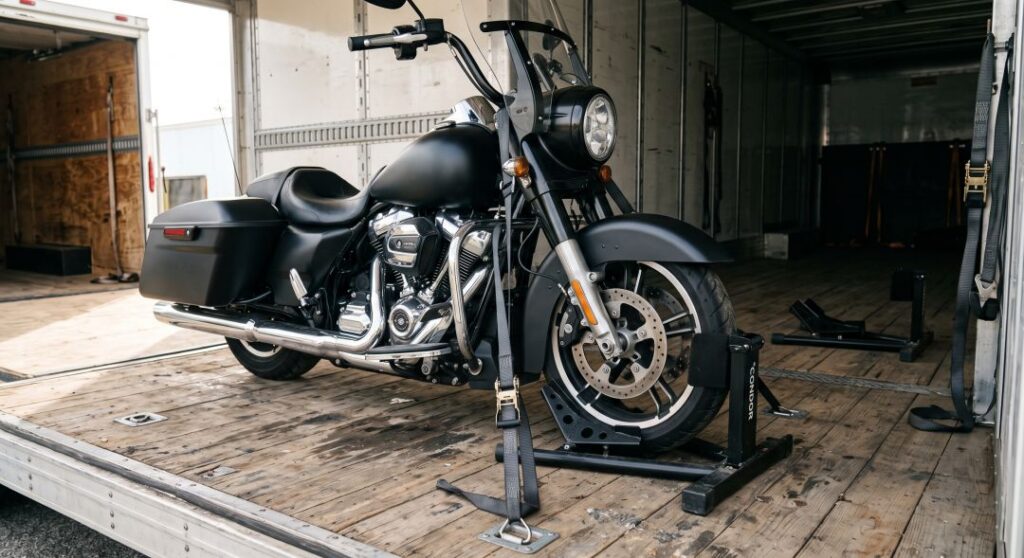
Shipping a motorcycle across the country is not a smaller version of shipping a car. Different equipment, different tie-downs, different insurance math, and a category where the most specialized companies are also the slowest. This guide ranks the five best companies to ship a motorcycle across the country, publishes what it actually costs in 2026, compares transit windows nobody else puts side by side, and shows you how to verify a company’s license and coverage in about a minute.
The 5 best companies to ship a motorcycle across the country
This list is not ordered by ad spend or star ratings. Each company is placed by the job it is genuinely best at, judged on published licensing, equipment, coverage limits, transit windows, and service scope. Where a company is a vehicle shipping broker rather than a trucking company, we say so, and every entry carries its trade-off.
HAULBIKES (Daily Direct): best for pure motorcycle shipping specialization
Since: 1994. Model: motorcycle and powersports only, no mixed loads. Coverage: $15,000 included, $500 deductible.
Milwaukee based with terminals in Las Vegas, Ocala, Oklahoma City, and Harrisburg. HAULBIKES ships Harley-Davidson freight nationwide and is used by dealers, manufacturers, and collectors. Only motorcycles and powersports go on the trailer, and each bike is individually secured by a strapping system designed for motorcycles. There is no need to crate or palletize, and your bike is delivered with fluids and battery intact. It also offers regional warehousing for inventory and distribution, a dealer and manufacturer service most consumer brands do not touch. Motorcycle specifications up to 58 inches high, 48 inches wide, and 108 inches long standing upright cover most trike/Spyder, ATV/UTV, scooter, and sidecar setups. Raise coverage at $35 per additional $5,000, or pay $50 for zero deductible. Your payment is what reserves the slot. Trade-off: HAULBIKES publishes an average of 21 to 28 business days from booking to delivery, and pricing is a custom HAULBIKES Quote rather than published standard rates, so you cannot comparison-shop from the website.Motorcycle Shippers: best for zero deductible and predictable pricing
Since: 1994. Coverage: $7,000 valuation, zero deductible. Transit: about 15 business days average.
Handles motorcycles, ATV/UTV, trikes, Slingshots, golf carts, and e-bikes across the contiguous US plus Hawaii, Alaska, Puerto Rico, and Canada. No crate, no packaging, the bike goes on as it sits. Two things earn it second place. Zero deductible on every shipment, and honest quote construction: door-to-door service is in the price with no separate residential fees, taxes, insurance, or fuel surcharges added later. Published standard rates average roughly $270 to $950 for a standard-sized bike. Most shipments are picked up within 1 to 10 business days and delivered 5 to 10 days after that, with online tracking available 24 hours a day. Trade-off: $7,000 of valuation is thin for a modern bike. If yours is worth $18,000, you are self-insuring $11,000 unless you buy up.USA Auto Transport: best for cross-country speed and shipping a bike with a car
Licensed: USDOT 3016637, MC-32073. Transit: 1 to 14 business days by mileage. Coverage: up to $500,000 enclosed, up to $100,000 open.
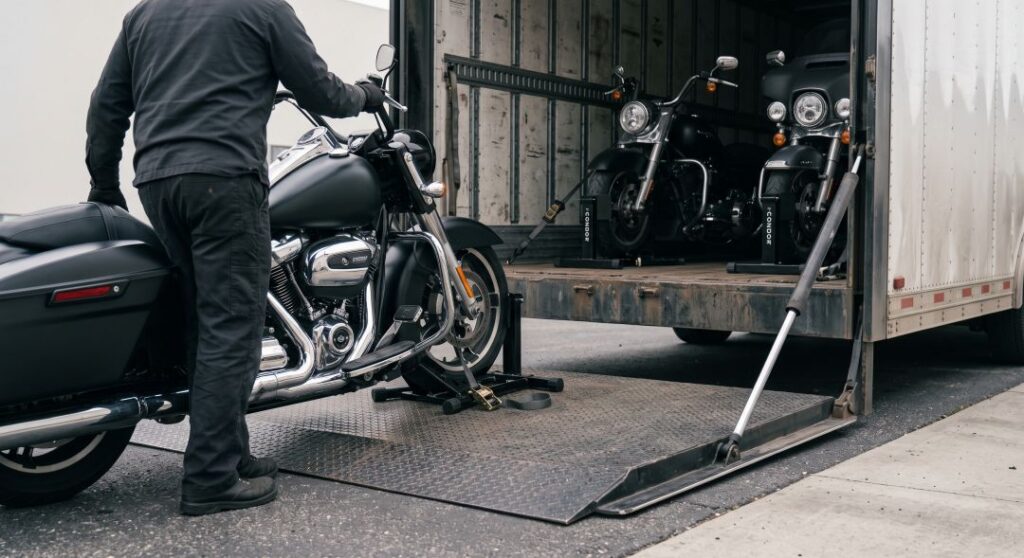
A Los Angeles based national operation running interstate vehicle shipping services. FMCSA lists the registration as a property broker, meaning it places your bike with vetted licensed carriers rather than driving the truck itself, the same structure Montway, AmeriFreight, and SGT use. What earns it third place is timing and breadth. Against 21 to 28 business days from the category’s biggest specialist, a 1 to 14 business day window is the difference between a move and a wait. Door-to-door delivery covers roughly 58 metro areas, with terminal-to-terminal available when you want the cheaper option. Both open transport and enclosed transport are available, with enclosed running hard-sided trailers, hydraulic lift gate loading, and wheel straps rather than chains. It also publishes motorcycle cost ranges, which almost nobody in this category does: $250 to $500 under 500 miles, $450 to $800 for 500 to 1,500 miles, and $700 to $1,200 and up for cross-country. Online shipment tracking plus phone dispatch updates, no payment until one business day before pickup, and no cancellation fee more than 72 hours before the pickup window opens. Trade-off: this is a car-first operation that handles motorcycles well, not a motorcycle-only hauler. Confirm bike handling on the phone: will it travel individually secured with soft straps, is the load covered, and what is the per-vehicle limit on the certificate of insurance.AmeriFreight: best gap coverage for a high-value bike
Licensed: USDOT 2238770, MC-597401. Since: 20+ years. Cost: $300 to $1,200 typical.
Roughly $300 to $600 under 500 miles and $950 to $1,200 for open transport past 2,000 miles, with an A rating and 1,500-plus reviews. Its differentiator is the AFTA plan, a gap layer over the carrier’s cargo coverage that lets you report damage up to 48 hours after delivery. That window matters more than it sounds, because damage found in a garage the next morning is normally a lost claim. Enclosed transport runs 30 to 50 percent more. Transit is quick by category standards: 1 to 3 days under 500 miles, 7 to 10 days past 2,000. Discounts stack for military, first responders, medical staff, students, returning customers, and additional bikes. Trade-off: the gap product is an add-on, not included. Price it into the comparison rather than treating the base quote as the number.Montway Auto Transport: best network reach and instant quoting
Volume: roughly 250,000 shipments a year, all 50 states. Payment: none upfront until a carrier is assigned.
Offers an instant quote with online booking plus international shipping coordination. Bikes ride on specialized platforms or a dedicated motorcycle pallet, with no fluid draining or battery disconnection required. Published transit brackets: 1 to 4 days under 800 miles, 4 to 7 days to 1,499, 6 to 10 days to 2,399, and 10 to 15 days past 2,400. A Los Angeles to New York bike move quotes around $1,300 door-to-door or about $1,129 through distribution centers. Trade-off: distribution center routing is cheaper because your bike waits. Ask how long before you pick that option.
Also worth a quote depending on the job: SGT Auto Transport (USDOT 2521690, MC-873392, 24/7 customer service lines, no upfront payment, ships a motorcycle alongside a car on one order), Easy Auto Ship (USDOT No. 3149259, MC-103888, Youngstown, Ohio, with broad route coverage including Hawaii and international lanes), and Easy Cargo Ship (USDOT No. 4532166, also Youngstown, Ohio, worth knowing that these two similarly named brands are separate broker registrations out of the same town, both with zero power units). Sherpa Auto Transport is the answer if quote creep bothers you more than paying a deposit, because the locked price is the product. Nexus Auto Transport and American Auto Shipping are mid-market brokers with competitive shipping quotes on dense lanes. Shiply and uShip are load-board marketplaces where carriers bid on your job to fill space on trips they are already running, and Shiply advertises up to 75% cheaper than standard rates on that basis. Real savings, real variance, and you are vetting the carrier yourself.
What best actually means for motorcycle shipping
The best company to ship a motorcycle across the country is the one whose transit window, coverage limit, and handling method match your bike. That is the whole answer. Everything below is how you tell them apart. Three questions decide it, in this order.
When does it need to arrive?
If the date is fixed, a specialist with a three to four week average is out, no matter how good the handling is.What is the bike worth?
If it is worth more than the included coverage, you are buying up or moving to a company with real per-vehicle limits.Is anything else moving?
A bike plus a car plus a household on three separate schedules is three chances for something to go wrong. One coordinator handling vehicle shipping alongside a household move removes two of them.
Answer those and the list above sorts itself.
Recommended pick for cross-country motorcycle transport: USA Auto Transport
The short version: if the date matters, this is the profile to book. A 1 to 14 business day window against 21 to 28 business days from the category’s biggest specialist is not a small gap, and being able to move the bike, the car, and the household on one timeline removes two of the three things that usually go wrong. Just confirm the tie-down method and the certificate of insurance on the phone first, because the quote form is built around cars.
Specialist hauler or vehicle shipping broker? Read it in 60 seconds
Most national motorcycle shipping brands are brokers, and disclosing that is a federal requirement, not a courtesy. Under 49 CFR 371.7, a broker may not represent its operations as those of a motor carrier and must do business under its registered name. Being a broker is not a strike against a company. Brokers reach a network of licensed carriers you could never assemble on your own, which is how a bike gets out of rural Montana in February. It just changes who is accountable for the truck.
The check takes one minute. Pull the USDOT number in FMCSA SAFER and read three fields.
Operating authority
Broker of Property means broker. Motor Carrier means it can run its own equipment.Power units
Zero trucks means zero trucks. Fastest tell there is.USDOT status and out-of-service date
You want active with no out-of-service date. Glance at the MCS-150 filing date too, because a badly stale filing says something about administrative habits.
Do it before you pay, not after.
Types of motorcycle transport, and which one you actually need
Open transport
The default, and fine for most bikes. Your motorcycle rides upright on a deck, secured in a wheel chock with soft straps, exposed to weather the same way it would be in your driveway. Cheapest option, widest carrier availability, fastest to book.Enclosed transport
Puts the bike inside a hard-sided trailer, covered from road debris, weather, and sightlines. Costs roughly 30 to 50 percent more. Worth it for custom paint, vintage machines, freshly restored bikes, and anything you would be sick about scratching.Crated or palletized
For freight lanes and overseas work. For domestic moves it is usually unnecessary and adds cost. Both motorcycle specialists explicitly tell you not to crate or palletize.Door-to-door versus terminal-to-terminal
Door-door transport means pickup at your address and delivery at the destination address, subject to truck access and local rules. Terminal-to-terminal is cheaper and slower, because your bike sits at a facility on both ends.
What motorcycle shipping costs across the country in 2026
Expect $700 to $1,200 for a standard cross-country motorcycle move on open transport, and roughly 30 to 50 percent more enclosed. Shorter runs land well below that.
| Distance | Open transport | Enclosed transport (est.) | Typical transit |
|---|---|---|---|
| Under 500 miles | $250 to $600 | $350 to $800 | 1 to 4 days |
| 500 to 1,500 miles | $450 to $950 | $600 to $1,300 | 4 to 7 days |
| 1,500 to 2,400 miles | $700 to $1,100 | $950 to $1,600 | 6 to 10 days |
| 2,400+ miles (coast to coast) | $950 to $1,300 | $1,300 to $1,900 | 7 to 15 days |
Six route factors move that number.
Distance, but not proportionally
Per-mile rates drop hard as total miles rise. SGT publishes about $1.42 per mile on enclosed under 700 miles against $0.41 per mile past 2,400.Lane density
Los Angeles to Florida is a highway. Rural Wyoming to rural Maine is not, and you pay for the deadhead.Seasonal demand
Spring and summer are peak for motorcycle riders, and snowbird season distorts Florida lanes in both directions. Winter is cheap and slow.Motorcycle specifications
Height, width, length, and weight decide how many bikes fit. A bagger with a tall shield and hard cases eats more deck than a scooter.Access and tolls
Long Island, Maine, and other toll-heavy or truck-restricted areas carry surcharges. HAULBIKES publishes a $300 toll charge on those lanes.Speed
Expedited pick up costs real money. Flexibility is the cheapest discount in this industry.
On quote shopping: an instant quote is a prediction, not an offer. Two companies quoting $700 and $1,150 on the same lane are often selling different products, one a live market bid and one a locked price. Some brokers offer price matching against a written competitor quote, which is worth asking about but is not the same as a guarantee on your final invoice. Compare deposit terms and cancellation windows, not just the headline.
The insurance section everyone skims and should not
Here is the thing that catches people. The specialists advertise insurance included, which sounds better than a broker saying the carrier’s cargo policy applies. Then you read the number. Fifteen thousand dollars with a $500 deductible. Seven thousand with zero deductible. A new Road Glide stickers above both. So specialist does not mean better covered. It often means the opposite, because a dedicated bike hauler is pricing a $7,000 to $15,000 average load, while an enclosed auto carrier is pricing a trailer full of cars.
Three things to get straight before you confirm anything.
Valuation is not insurance
Valuation coverage is a liability limit under the carrier’s tariff, capping what they owe you. An insurance policy is a separate instrument. Ask which one you are being sold.Per-trailer is not per-vehicle
A $500,000 enclosed policy across four vehicles is not $500,000 for yours. Do the division. Under 49 CFR 387.303, household goods carriers must carry only $5,000 for loss on any one vehicle, and general property carriers face no federally mandated cargo minimum at all. Everything above that is voluntary.Verify independently
FMCSA’s Licensing and Insurance system shows what is actually filed against a USDOT number, which is not always what a sales email says.
Then ask the only question that matters: what is the per-vehicle limit, and will you email me the certificate before pickup?
Transit time: the number nobody compares and everyone should
This is the most useful finding in this guide, so it gets its own section.
| Company | Published transit | Model |
|---|---|---|
| USA Auto Transport | 1 to 14 business days by mileage | Broker, national carrier network |
| AmeriFreight | 7 to 10 days at 2,000+ miles | Broker |
| Montway Auto Transport | 10 to 15 days at 2,400+ miles | Broker |
| Motorcycle Shippers | About 15 business days average | Motorcycle shipping specialization |
| HAULBIKES | 21 to 28 business days average | No mixed loads, motorcycle only |
The pattern is counterintuitive and it is structural, not a criticism. A motorcycle-only hauler fills a trailer with motorcycles going roughly the same direction, and that takes time. A broker taps thousands of licensed carriers and finds one already running your lane this week. If handling purity matters more than the calendar, take the specialist and plan for a month. If the date is real, book the broker. Just do not discover this after you have paid.
Safety and protection: where bikes actually get damaged
Not on the interstate. On and off the truck, and in the tie-down.
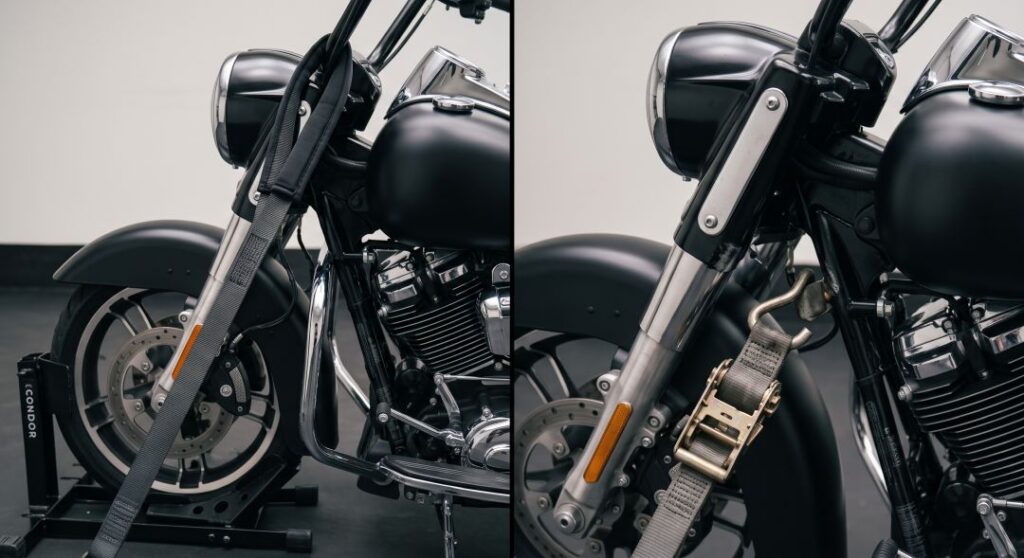
Tie-down method
A motorcycle strapped through the frame or triple clamps with hard ratchets compresses the forks for days and can damage seals and bushings. A proper strapping system uses a front wheel chock and soft straps over the bars or handlebar risers, with the suspension carrying load the way it was designed to. Ask specifically whether your bike travels individually secured or wedged between cars on a shared deck.Loading
Low fairings, long trikes, and heavy baggers do not belong on a steep ramp. A hydraulic lift gate keeps the bike level and the fairing off the pavement.Documentation
A proper handover means a signed Bill of Lading, timestamped photos at both ends, and a walkaround with the driver. If a company shrugs at photo documentation, that tells you exactly how a claim will go. This is the single best predictor of safety and protection discipline in the whole booking.Weather
An uncovered bike on a four-day run through the Rockies in March will arrive dirty and possibly salt-dusted. That is not damage, but it is a reason to choose enclosed transport on a show bike.
How to prepare your motorcycle for transport
Good news first: not much. Reputable haulers explicitly do not want you draining anything. Your bike travels with fluids and battery intact, and you do not need to crate it. Work through this the day before pickup.
Wash it
You cannot document damage on a dirty bike, and neither can the driver.Shoot a video walkaround
Continuous, well lit, close on wheels, pipes, tank, and fairing. This is your claim file.Drop the fuel to about a quarter tank
Less weight, less risk, enough to ride off the truck.Strip the loose stuff
Saddlebags, GPS mounts, cameras, windshields taller than the carrier’s limit, aftermarket mirrors. Packed hard bags are usually fine if they lock, but ask.Kill the alarm and disconnect toll transponders
A motion-triggered alarm on a moving trailer drains a battery in two days.Check for active leaks
Oil or coolant on the deck is how a shipment gets refused at pickup.Note the odometer and hand over one key
Someone has to be present at both pick up and delivery to sign the inspection report.Book early
Three to four weeks minimum, six in peak season. Full preparation checklist here, and the 2026 motorcycle, ATV, and jet ski pricing guide here.
Should you ship it or just ride it?
Worth doing the math honestly, because a lot of riders talk themselves into the trip. Three thousand miles at 45 miles per gallon is roughly $250 in fuel, plus five to seven nights of motels, plus food, plus the wear. Call it $1,200 to $1,800 realistically, which is more than most shipping quotes, plus a week of your life and a set of tires.
Then there is the part nobody prices. NHTSA counted 6,228 motorcyclist deaths in 2024, about 16 percent of all traffic fatalities, and reports that per mile traveled motorcyclists are almost 27 times more likely to die in a crash than passenger vehicle occupants. A cross-country run is a meaningful chunk of annual mileage compressed into a week, much of it on unfamiliar roads while tired. Ride it because you want the ride. That is a great reason. Just do not tell yourself you are saving money.
Mistakes that cost riders real money
Booking the cheapest quote on a thin lane
Often a company that has not secured a truck yet and will come back for more.Assuming insurance included means fully covered
Read the number, then compare it to your bike’s value.Skipping the SAFER lookup
Ninety seconds prevents the entire category of shipping fraud.Not asking how the bike is tied down
Frame straps and compressed forks for two weeks is a fork seal job you will pay for yourself.Booking a specialist three days before a hard deadline
Read the transit table again.Leaving the alarm armed
Dead battery, plus a driver who now has to push your bike off the truck.
Frequently asked questions
- How much does it cost to ship a motorcycle across the country?
- Between $700 and $1,300 on open transport for a coast-to-coast move, and roughly 30 to 50 percent more for enclosed transport. Shorter distances drop fast: under 500 miles typically runs $250 to $600. Price is driven by distance, lane density, seasonal demand, motorcycle specifications, and how flexible your dates are. Published 2026 ranges from USA Auto Transport put cross-country motorcycle moves at $700 to $1,200 and up.
- How long does motorcycle shipping take across the country?
- Usually 7-14 business days door-to-door when a national broker places your bike with a carrier already running the lane. Dedicated motorcycle haulers take longer because they wait to fill a trailer with bikes: Motorcycle Shippers averages about 15 business days and HAULBIKES publishes 21 to 28 business days from booking to delivery. If your date is fixed, ask for the published window in writing before you reserve.
- Do I need to crate my motorcycle or drain the fluids?
- No, not for domestic motorcycle transport. Reputable haulers load the bike upright with fluids and battery intact and secure it individually with a soft strapping system. You should drop the fuel to about a quarter tank, remove loose accessories, and disable the alarm. Crating and palletizing are mostly for international shipping and freight lanes, where they add real cost.
- Is enclosed transport worth it for a motorcycle?
- For a custom, vintage, freshly restored, or show bike, yes. Enclosed transport blocks road debris, weather, and public view, and it usually comes with higher coverage limits. For a stock daily rider moving in fair weather, open transport is a defensible risk and saves 30 to 50 percent. The deciding question is whether you would be genuinely upset by a stone chip.
- How do I know a motorcycle shipping company is legitimate?
- Look up the USDOT number in FMCSA’s SAFER database and check three fields: operating authority (broker or motor carrier), power unit count, and active status with no out-of-service date. Then request the certificate of insurance with the per-vehicle limit stated, and confirm the deposit and cancellation terms in writing. A company that will not send a certificate before pickup has told you something useful.
The bottom line
Best company to ship a motorcycle across the country is a matching problem dressed up as a ranking problem. A motorcycle-only hauler with no mixed loads and a purpose-built strapping system is the right answer for a collector bike with no deadline, and the wrong answer if the buyer is waiting. A national broker with a 1 to 14 business day window is the right answer for a relocation and the wrong answer if you want the same three people touching your bike end to end. What separates a good outcome from a bad one is almost never the logo on the trailer: it is whether you checked the USDOT registration, compared the coverage limit to what the bike is actually worth, and asked how it gets tied down. For a route-specific estimate, get a free quote, read the car shipping FAQ, or call 323-524-0031.