How to Ship an Electric Vehicle (EV): Special Requirements and Costs
Shipping an electric vehicle in 2026? See real cost ranges, the state-of-charge rules carriers apply, battery safety steps, and how EV transport differs.
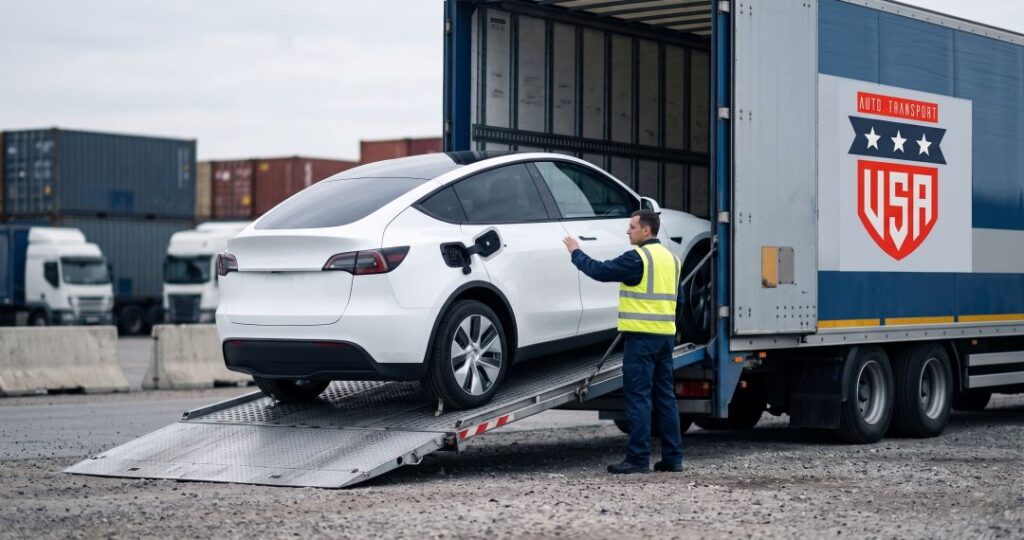
Shipping an electric car is not the same job as shipping a Camry. The vehicle is heavier, the battery has its own rulebook, and half the drivers on the road still do not know how to put a Tesla in neutral without draining the 12V battery.
None of that makes it hard. It makes it specific. Here is what actually changes, what it costs in 2026, and where people get it wrong.
Quick answer: what shipping an EV costs and what changes
For a running electric car on an open carrier in 2026, expect roughly $600 to $2,100 depending on distance. Enclosed transport runs about 30% to 60% higher.
Three things separate an EV from a gas car in a carrier’s eyes: vehicle weight, the specialized handling at load-in, and the value of the asset. The battery itself is rarely the problem. A sealed, undamaged pack sitting in a car that drives onto a trailer is one of the least eventful things a carrier handles.
The exceptions matter, though, and we get to them below: damaged packs, salvage EVs, ocean freight, and air freight.
2026 EV shipping costs in the United States
These are realistic 2026 ranges for a running electric vehicle in normal condition, door to door.
| Distance | Open transport | Enclosed transport | Typical transit time |
|---|---|---|---|
| Under 500 miles | $600 to $950 | $900 to $1,400 | 1 to 3 days |
| 500 to 1,000 miles | $800 to $1,150 | $1,150 to $1,700 | 2 to 4 days |
| 1,000 to 1,500 miles | $950 to $1,450 | $1,400 to $2,100 | 3 to 6 days |
| 1,500 to 2,500 miles | $1,200 to $1,800 | $1,800 to $2,700 | 5 to 9 days |
| Coast to coast (2,500+ miles) | $1,400 to $2,100 | $2,000 to $3,200 | 7 to 12 days |
Long routes cost less per mile than short ones. A 400 mile hop can price out above $1.50 per mile. A coast-to-coast run often lands between $0.55 and $0.75 per mile. This surprises people every time.
Why EVs cost more than gas cars
Weight, mostly. Carriers work against a federal gross limit of 80,000 pounds, so vehicle size and every pound of your car compete with the next car’s slot on the deck.
Electric cars are consistently heavier than their gas equivalents. A Tesla Model 3 RWD runs about 7% heavier than a comparable BMW 330i. An F-150 Lightning is over 20% heavier than a gas F-150. The lithium-ion batteries commonly account for 25% to 30% of the car’s mass, and then the structure around them gets reinforced too. The GMC Hummer EV’s pack alone weighs about 2,900 pounds.
| Vehicle class | Examples | Typical premium over a gas equivalent |
|---|---|---|
| Compact EV | Nissan Leaf, Chevrolet Bolt | Little or none |
| Mid-size EV | Tesla Model 3, Model Y, Hyundai Ioniq 5 | $75 to $150 |
| Full-size electric SUV or luxury sedan | Tesla Model X, Lucid Air, Rivian R1S | $150 to $250 |
| Electric pickup | Tesla Cybertruck, F-150 Lightning, Hummer EV | $250 to $500, and fewer available slots |
The Tesla Cybertruck deserves its own note. At 6,700 to 6,900 pounds with an unusual profile, it does not slot neatly onto a standard rack, and some carriers will not take it at all on open decks. Book early.
Is an electric vehicle considered hazardous materials?
Not for domestic road transport in the United States. This is the single most common misunderstanding in EV shipping, and it costs people money when brokers use it to justify a surcharge.
The relevant text is 49 CFR 173.220(c): battery-powered vehicles “are not subject to any other requirements of this subchapter except § 173.21 when transported by rail, highway or vessel.” Batteries must be securely installed and protected against heat, short circuits, and terminal damage, which any factory-built EV already satisfies.
So: no hazmat placards, no dangerous goods declaration, no special provisions paperwork for a normal EV going from Phoenix to Chicago.
Paragraph (d) does still apply to lithium-powered vehicles, and it is short: the battery must be securely fastened, protected against damage and short circuits, and must have passed the UN Manual of Tests and Criteria. A factory EV clears all three the day it leaves the plant. The one hard prohibition in (d) is that lithium metal battery vehicles are forbidden aboard passenger aircraft.
Two situations flip the road picture entirely.
A damaged, defective, or recalled battery. PHMSA’s safety advisory on EV and lithium battery transport is direct about it: damaged packs are “more likely to experience thermal runaway and ignite.” Under 49 CFR 173.185(f) they may move by highway, rail, or vessel only, are forbidden on aircraft entirely including cargo aircraft, and require specification packaging plus a “Damaged/defective” marking at least 12 mm high. PHMSA also puts the burden on the shipper, not the carrier, to determine whether a battery is damaged.
Anything crossing an ocean. International rules are a different animal, and they changed this year.
If your EV has been in a flood, a fire, or a significant collision, tell the carrier before you book. A salvage EV is a specialty move requiring specialized equipment and, often, a carrier with a hazmat endorsement.
What changed for international EV shipping in 2026
If you are shipping outside North America, the classification you used last year is no longer valid.
IMDG Code Amendment 42-24 took effect on January 1, 2026. The generic UN 3171 “battery-powered vehicle” entry is no longer permitted for lithium and sodium-ion vehicles. Per Maersk’s regulatory notice, ocean carriers now require a battery-specific Class 9 entry.
| New UN number | Applies to |
|---|---|
| UN 3556 | Vehicle, lithium ion battery powered |
| UN 3557 | Vehicle, lithium metal battery powered |
| UN 3558 | Vehicle, sodium ion battery powered |
UN38.3 certification. Every lithium battery in commerce must have passed the UN Manual of Tests and Criteria, Part III, subsection 38.3 tests. For a production EV the manufacturer holds the UN38.3 test summary. Freight forwarders increasingly ask for it on international bookings, so request it from the manufacturer early rather than at the port.
Special Provision 962 applies to these entries, and Maersk recommends placarding containers on all four sides because port interpretations vary.
Air freight is the strict one
Air freight is where the rules bite hardest. Under the IATA Dangerous Goods Regulations 67th edition, effective January 1, 2026, a UN 3556 vehicle with a battery over 100 Wh ships at a 30% maximum SoC, under Class 9 with Packing Instruction 952, with an SoC declaration alongside the UN38.3 summary. Anything above 30% needs approval from both the State of Origin and the State of the Operator under Special Provision A331. In practice, vehicles arriving over the limit get refused at the terminal.
Air is almost never the right answer for a consumer EV anyway. The cost is typically five to ten times ocean container shipping for the same lane.
State of charge: what to actually set it to

There is no single legal number for domestic road transport in the United States. There are strong conventions, and they exist for good reasons.
| Transport mode | Typical SoC target | Who sets it |
|---|---|---|
| Open or enclosed truck (domestic) | 30% to 60% | Carrier policy, not law |
| Ocean vessel and RoRo ships | 20% to 50% | Ocean carrier policy, following EMSA guidance |
| Air freight | 30% maximum | Airline and IATA rules, enforced |
The European Maritime Safety Agency guidance tracked by the ECG vehicle logistics association recommends 20% to 50% for battery electric vehicles on car carrier vessels, and most shipping lines adopted the 50% ceiling.
A high SoC stores more energy. More stored energy means a bigger event if something goes wrong, which is the whole logic behind battery safety regulations at sea and in the air.
A very low SoC creates its own problems. Below 15% you may not have enough charge to load, reposition, and drive off at delivery, especially if the car sits in a yard for a few days. Deep discharge over a long transit also contributes to battery degradation.
Thermal stress cuts both ways. A pack held at high charge in a hot trailer in July is under more thermal stress than one at 40%.
Practical rule: charge to about 50%, then ask your carrier if they want something different. Some do.
Battery safety protocols during transport
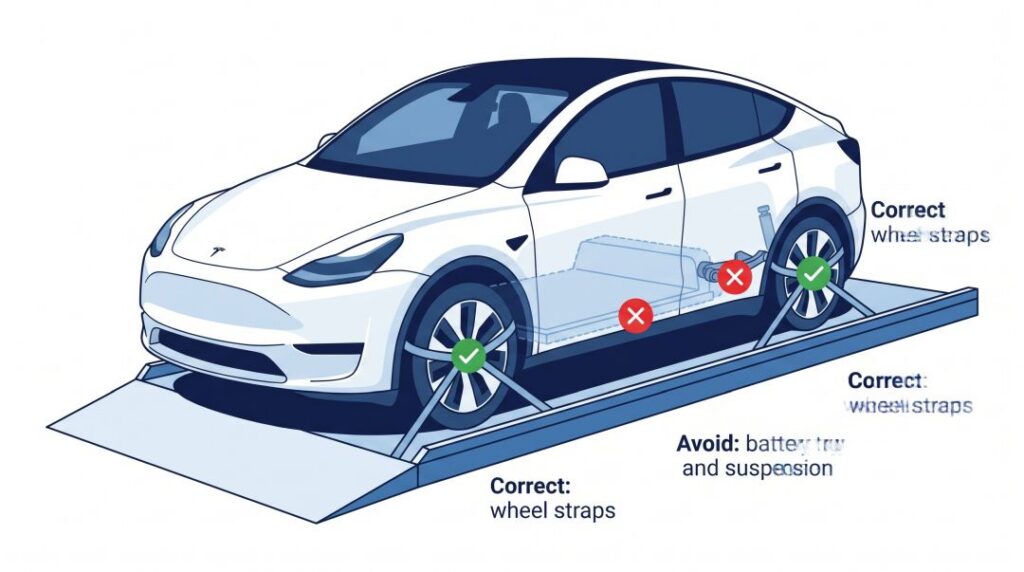
Good carriers do a handful of unglamorous things. The specialized loading techniques below are the whole difference between a clean delivery and a claim, and asking about them tells you fast whether a company actually moves electric cars or just says it does.
No charging in transit
The car stays off and unplugged. Charging cables come out of the frunk and travel with you, or get boxed and labeled.Correct tie-down points
Straps go over wheels or onto manufacturer-designated points, never across battery trays, underbody shielding, or suspension components. This is the failure mode that damages EVs most often.Wheel-strap loading, not chassis chains
Wheel nets distribute load through the tires and let the suspension do its job.Attention to weight distribution
A heavy EV usually rides on the lower deck, positioned for axle balance rather than convenience.High-voltage awareness
Drivers should know where the high-voltage systems and service disconnect sit on common models, and should never touch orange cabling.Temperature management
Enclosed trailers moderate extremes better than open decks. Genuine climate control is rare and rarely necessary for a healthy pack.Remote triggers off
Sentry Mode, scheduled charging, remote climate, and app-triggered summon all need to be disabled. A car that wakes up and tries to move on a trailer is a genuine hazard.
On battery fire risk: incidents involving intact, undamaged traction batteries in transport are rare. NHTSA’s Battery Safety Initiative tracks thermal runaway, water immersion, and vibration resistance under GTR No. 20, and its investigations center on crash, water-immersion, and manufacturing-defect cases rather than routine hauling. That is the honest picture. It is not zero risk, and it is not the crisis some shipping quotes imply.
A note on marketing language you will encounter: some brokers advertise fireproof casing or fire-suppression blankets on EV moves. Blankets and containment products exist and a few specialty carriers carry them. They are not a regulatory requirement for an intact vehicle in the United States, and no reputable carrier should charge you a large premium in their name.
Open vs enclosed transport for an electric car
| Factor | Open carrier | Enclosed carrier |
|---|---|---|
| 2026 cost | Baseline | 30% to 60% higher |
| Vehicles per load | Up to 10 | Up to 4 |
| Weather, dust, road debris | Exposed | Fully protected |
| Loading | Ramps | Lift gate, better for low ground clearance |
| Typical liability coverage | Lower | Substantially higher |
| Best for | Everyday EVs, leases, dealer moves | Performance, luxury, and collector EVs |
Open transport handles the majority of EV moves in America and handles them fine. A Nissan Leaf or a base Model 3 does not need a covered trailer, and the open carrier auto transport option is the reason most people can afford to ship at all.
Enclosed transport earns its premium in three cases: the car is worth more than about $70,000, it has low ground clearance or aero panels that ramps can catch, or the route runs through winter salt. The enclosed auto transport service page covers lift gate loading, the four-vehicle limit, and coverage up to $500,000, which matters more on an EV than people expect. Replacing a damaged pack on a modern electric car can run $15,000 or more.
USA Auto Transport’s electric vehicle transport service quotes liability coverage of $100,000 on open trailers and $500,000 on enclosed containers, which is a useful benchmark when you compare insurance coverage across quotes.
Door-to-door, terminal-to-terminal, or something else
Your transport mode choice affects both price and how much of your day it eats.
Door-to-door delivery
The default and the easiest. The driver collects the car at your address and delivers to the destination address. Dense city blocks and gated communities sometimes require meeting at a nearby lot, which is normal and does not change your rate. Details on the door-to-door auto transport page.Terminal-to-terminal transport
Cheaper, but you drive to and from a yard and your EV may sit for days. If it sits, SoC drifts down. Factor that in.Expedited shipping
Buys a narrower pickup window, at 20% to 40% more.Container shipping and RoRo ships
These cover international transport. RoRo is cheaper. A container gives better protection and lets you ship at a declared SoC with cleaner documentation.Load-board marketplaces
Platforms like uShip put your listing in front of independent carriers. You can find good prices there. You are also doing your own vetting, and for an EV that means confirming the driver has actually loaded one before.
How to prepare your EV for shipping
Charge to roughly 50%
Then confirm the target with your carrier. Some ask for a different number, and their policy wins.Disable scheduled charging, Sentry Mode, and remote features
These are the remote triggers that cause trouble in transit.Learn the tow and transport procedure for your model
Most EVs need to be placed in neutral or tow mode before they can roll. On many Teslas this is a touchscreen sequence, and once the car is on the trailer you cannot always redo it. Print the steps or bookmark them for the driver.Check the 12V battery
This is the quiet killer. If the low-voltage battery is weak, the car may not wake up to shift into neutral or open its doors at delivery. If yours is old, replace it before shipping.Remove the charging cables and adapters
Or box and label them. Mobile connectors walk off.Take out all personal belongings
Carriers are not licensed to haul personal belongings in the vehicle, and loose items add weight and shift in transit.Do a full vehicle inspection and photograph everything
Every panel, both bumpers, all four wheels, the roof, and the odometer. Timestamped. This is your condition documentation and the only real defense on a pre-existing damage dispute.Note the current mileage and charge level on the Bill of Lading
The car bill of lading is the legal record of your vehicle’s condition at pickup. Read it before you sign. Do not accept a blank one.Leave two key fobs if you can
And tell the driver about any active warning lights. Some carriers refuse vehicles showing high-voltage or brake system alerts, and finding that out at pickup wastes everyone’s day.Inspect again at delivery, before signing
Compare against your photos in daylight. Note anything new on the Bill of Lading at that moment, not the next day.
Hybrid cars are simpler. A hybrid vehicle with a small pack sits closer to a gas car in weight and handling, and its battery attracts no extra procedure on domestic road transport. Plug-in hybrids follow EV guidance on SoC and cables.
Model-specific quirks are worth ten minutes of reading before pickup. Charge port placement, ride height settings, and tow procedures differ across the most popular electric cars on American roads, and the driver will not necessarily know yours.
What experienced EV shippers know that guides skip
The 12V battery causes more delivery problems than the traction battery. Ask any driver who has moved a hundred electric cars. A dead low-voltage battery means a car that will not shift, unlock, or roll off the deck.
“EV specialist” is not a certification. There is no federal EV endorsement for auto transport. When a company calls itself an EV specialist, the meaningful questions are how many they move per month, which models, and whether the driver assigned to your load has done it before.
Ground clearance decides more moves than weight. A lowered Model S or an air-suspension Lucid on a low setting will scrape a standard ramp. That is a lift gate job, which means an enclosed trailer, which changes your price. Mention ride height when you request quotes and you will get accurate numbers the first time.
Regenerative braking makes rollback behave differently. During loading, an EV in neutral does not hold on regenerative braking the way it does when driving. Drivers used to gas cars sometimes expect resistance that is not there. It is a small thing, and it is exactly the small thing that dents a bumper.
Your quoted price assumes your car drives. An EV that cannot power up becomes a winch load, which costs $100 to $200 extra and needs a carrier equipped for it. If your car is dead, say so upfront.
Shipping an EV overseas: the paperwork reality
Customs clearance is where international EV moves stall, not the ocean crossing. You will need the title, a bill of sale, the Bill of Lading, and increasingly the UN38.3 summary and an SoC declaration. Build in two extra weeks over what a gas car would take.
Norway. The country has the highest EV share on earth, so Norwegian import requirements get asked about a lot. Norway sits in the EEA and accepts EU type approval, which a US-spec EV does not have. That means individual first-time approval through the Norwegian Public Roads Administration, plus VAT and a scrap-deposit fee. Norway’s long-standing EV VAT exemption is closing: the December 2025 budget set the exempt threshold at NOK 300,000 for 2026, dropping to NOK 150,000 in 2027, with full abolition in 2028. Do the math before you book freight, because on an older EV the import cost routinely exceeds what the car is worth.
Clearing up CE marking. You will see CE marking mentioned in EV export threads. It does not apply to cars. Passenger vehicles entering Europe need EU type approval or individual national approval. CE marking covers equipment like your portable charger and wall box, which is worth knowing, because a non-compliant charging accessory can be held while the car itself clears.
Puerto Rico is domestic but behaves like an export. Shipping runs by ocean from Jacksonville and other Southeast ports, and the island levies an excise tax based on assessed vehicle value, which on a newer EV can be substantial. Get the tax estimate before you book the freight.
Manufacturers you will see in international lanes but not in US showrooms, BYD most of all, ship under the same UN 3556 framework. If you are importing one privately, the classification is the easy part and FMVSS compliance is the hard part.
Choosing a carrier: what to verify
Any legitimate US auto transporter or broker holds a USDOT number and MC operating authority. Both are free to check through the FMCSA Company Snapshot tool. USA Auto Transport, as one example, is registered under USDOT 3016637 and MC-32073.
While you are in there, check what kind of authority the company actually holds. A broker of property arranges your move with vetted carriers. A motor carrier runs its own trucks. Most national names in auto transport are brokers, and there is nothing wrong with that. It just means the driver who shows up works for somebody else, so ask which carrier is assigned and confirm that carrier’s insurance, not only the broker’s.
How many electric vehicles do you move a month, and which models?
Vague answers mean vague experience.What is your liability limit on my trailer type, and can I see the certificate of insurance?
Compare against the $100,000 open and $500,000 enclosed benchmark.What state of charge do you want, and do you have a policy in writing?
A carrier that moves EVs regularly has a number ready.Where does the driver attach the straps on my model?
The right answer mentions wheels or designated points. Any answer involving the underbody is a red flag.What happens if the car will not wake up at delivery?
You want to hear that they have dealt with it before.
Then read recent reviews for patterns, not individual complaints, and never take the lowest quote in a spread without asking why it is low.
Frequently asked questions
- How much does it cost to ship an electric vehicle in 2026?
- Most EV owners pay $600 to $2,100 on open transport and $900 to $3,200 on enclosed transport, depending on distance. An electric car typically costs $75 to $250 more than a comparable gas car on the same route, mainly because of extra vehicle weight. Electric pickups like the Tesla Cybertruck can add $250 to $500.
- Is an electric car classified as hazardous materials for shipping?
- Not for domestic road transport in the United States. Under 49 CFR 173.220(c), battery-powered vehicles moved by highway, rail, or vessel are excepted from nearly all hazmat requirements, provided the battery is securely installed and protected. Damaged, defective, or recalled batteries are a different case and fall under 49 CFR 173.185(f). International ocean shipments must be declared as UN 3556, UN 3557, or UN 3558 as of January 1, 2026.
- What state of charge should my EV be at for shipping?
- Aim for about 50%, then confirm with your carrier. Domestic road transport has no legal SoC limit in the US but most carriers ask for 30% to 60%. Ocean carriers generally cap it at 50% following EMSA guidance, and air freight enforces a 30% maximum.
- Should I ship my Tesla on an open or enclosed carrier?
- For a standard Model 3 or Model Y, open transport is safe and considerably cheaper. Choose enclosed transport for a Model S Plaid, a Model X, a Cybertruck, or any EV worth more than roughly $70,000, and whenever ground clearance means the car needs lift gate loading instead of ramps.
The bottom line
Shipping an electric vehicle in America costs a little more than shipping a gas car and requires a handful of specific steps. Set the charge near 50%. Kill the remote features. Check the 12V battery. Photograph everything and read the Bill of Lading before you sign it.
The regulatory picture is simpler than most articles suggest domestically, and stricter than most people expect internationally. If you are staying inside the United States, no hazmat paperwork applies to your intact EV. If you are crossing an ocean in 2026, the UN number on your booking has changed and getting it wrong will hold your car at the port.
Ready to price a specific move? Request quotes with your model, ride height, and dates, and ask each company the five carrier questions above before comparing numbers.