Moving an Electric Vehicle vs. a Conventional Vehicle: Costs and Differences
Does shipping an EV cost more than a gas car? See how battery weight, trailer capacity, charge level, and condition shape your auto transport quote today.
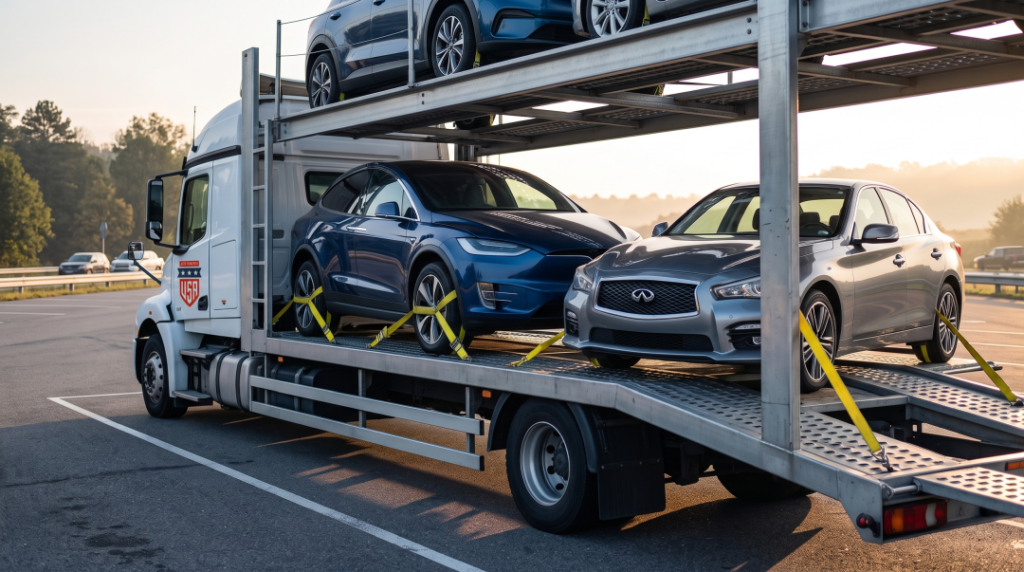
Shipping an EV is not some exotic, specialist-only job. A healthy, running electric vehicle usually rides on the same standard open and enclosed auto carriers that carry conventional vehicles every day. What changes the price is not the powertrain itself. It is weight, size, value, condition, and how much handling the car needs.
Rates on the same lane are often the same as for a comparable gas vehicle. Some carriers add a weight-related surcharge. Plenty do not. There is no universal EV surcharge, whatever you may have read. Quotes depend mostly on distance, route demand, seasonality, your pickup and delivery locations, carrier type, vehicle dimensions, whether the car runs, and how much space carriers have that week.
One thing to be clear on: this is about what it costs to move the car, not what it costs to own or charge it. Battery electric vehicles (BEVs), plug-in hybrid electric vehicles (PHEVs), hybrid cars, and internal combustion engine vehicles, whether that traditional internal combustion engine powered by gasoline or by diesel, all follow standard vehicle shipping rules. Battery-powered vehicles just need a bit more attention to charge level and battery condition.
Electric Vehicle vs. Conventional Vehicle Moving Costs at a Glance
Battery weight can push a quote up when it eats into carrier load capacity or makes the car harder to place on the trailer. But a compact EV can easily cost less to ship than a big gas SUV, a modified truck, or a luxury car on the same route.
For charge level, recommendations vary. One published guide suggests 30 to 60 percent for an operable EV on a domestic road move, and others land closer to a 20 to 60 percent charge. Go with what your carrier and the vehicle manufacturer tell you. And no, a forklift is not a normal way to load an EV. Lifting from the wrong points can damage battery compartments, the battery tray, underbody sensors, or the floor pan.
Side-by-Side Transport Comparison
A fair comparison means similar dimensions, value, condition, origin, destination, and transport method. Otherwise you are comparing services, not powertrains.
| Cost Factor | Electric Vehicle | Conventional Vehicle |
|---|---|---|
| Vehicle weight | The battery pack can raise curb weight | Often lighter within the same class |
| Carrier capacity | May reduce available payload or change carrier slot assignment | Usually more load-planning flexibility |
| Energy level | Usually shipped with a partial charge | Usually shipped with limited fuel |
| Loading needs | Charge status, ground clearance, and battery warnings must be disclosed | Fuel leaks, mechanical condition, and clearance still matter |
| Insurance | Higher vehicle value and battery damage can affect coverage | Value, modifications, and condition affect coverage |
| Transport choice | Open or enclosed shipping for suitable vehicles | Open or enclosed shipping as well |
| Main price drivers | Route, size, weight, condition, service, demand | Route, size, weight, condition, service, demand |
Look at that last row. Same list. That is the whole point.
For containerized international moves, a freight provider also weighs the vehicle load-rate per container against securing space and legal weight limits. Goods and Services Tax (GST), increased fuel costs, and border charges can land on the final invoice no matter what powers the car.
What Actually Determines the Price to Move a Vehicle
Distance matters. It is not the whole story. Busy routes tend to have more trucks available, while remote origins, tricky delivery spots, seasonal demand, fossil fuel prices, and fuel surcharges can make a shorter run cost more per mile than a long one.
Door-to-door delivery normally means the truck gets as close to your address as it can safely and legally go. Terminal or depot service exists in some markets. Expedited service costs more because it squeezes the scheduling window.
Size and operability are big ones. A tall pickup, a long-wheelbase SUV, or a sedan that will not start takes up more space or more labor than a small car that drives on and off.
Federal hazardous-material rules can come into play for specialized battery shipments. 49 CFR §173.185 covers lithium cells and batteries, and 49 CFR §173.185(f) has specific provisions for damaged or defective batteries. Neither creates a blanket rule that every intact EV must ship as loose battery cargo. Lithium battery designs themselves are generally expected to meet the UN38.3 testing criteria before they can be transported at all, which is part of why an undamaged EV is treated as a vehicle, not a hazmat load.
Ask for written, itemized quotes with the same route, dates, vehicle description, transport method, delivery expectations, and insurance terms. If those do not match, the price gap probably reflects different services, not EV versus gas.
Vehicle Value, Condition, and Transport Method
Enclosed transport makes sense for valuable cars of either kind. It keeps out weather, road debris, and road salt. Open transport costs less and works fine for most everyday vehicles, cold weather included, as long as the battery is healthy and the manufacturer’s instructions are followed.
An inoperable, damaged, modified, or low-clearance car may need a winch, flatbed transport, skates to roll it into position, modified ramp angles, or more labor. International moves add customs clearance, port fees, and paperwork that sit outside the carrier’s basic transport charge.
How EV Battery Weight Can Raise Auto Transport Rates
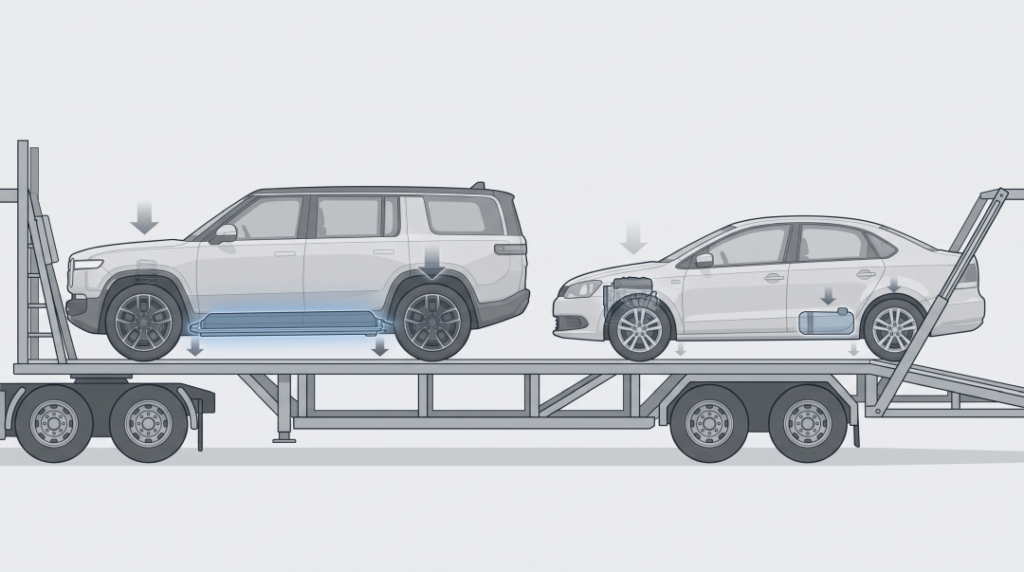
The most consistent difference is battery mass. A big pack can make an EV noticeably heavier than a similar-sized gas model, and that affects carrier deck planning and legal payload limits.
Vehicles-per-load economics explain why. A carrier earns money per vehicle on the trailer, but the whole load has to stay within legal limits and safe axle weights.
Say a load has room for eight cars by physical size. If adding one heavy EV would push the rig over its permitted weight, the carrier may have to drop another car, change slot assignments, or rebuild the whole load. Fewer vehicles per load means each remaining car has to cover more of the trip’s cost.
So the EV has not created some fixed surcharge. It has changed the math for that trailer, that route, and that group of cars.
A compact EV can still get a sharp quote when its weight fits the available capacity and the carrier needs a car its size for a particular deck spot. Flip it around, and a heavy gas pickup can cause a bigger capacity headache than a small EV.
Trailer Capacity and Weight Distribution
Auto haulers have to manage weight distribution across the vehicle combination: decks, trailer axles, and the tractor. Floor-mounted batteries give most EVs a low center of gravity, which helps. Total curb weight, wheelbase, height, and loading position still matter.
US rules under 49 CFR §173.220 cover vehicles and equipment powered by batteries or fuel when they are shipped as cargo. Depending on condition and shipment type, inoperable or damaged EVs may need a flatbed or a specialized EV carrier instead of routine multi-car service.
When weight limits cut the number of cars on a load, each one has to bring in more revenue for the trip to work. That is why the same model can get different quotes on different routes or dates.
Why a Comparable Gas Car May Be Cheaper to Ship
A lighter gas car gives the carrier more payload flexibility, so it can fill more spots without going over legal limits. On a single car, the slightly heavier curb weight of EV’s might change nothing. In fleet relocations, small per-vehicle differences can change how many loads you need, which is why fleets often use staggered pickups to spread heavier vehicles across trucks.
EV shipments may also come with specialized handling protocols for battery safety and different insurance requirements. A collision-damaged battery needs careful assessment, because post-crash lithium-ion battery reignition is a recognized emergency-response concern, as explained in federal NHTSA electric and hybrid vehicle guidance. Damaged cells can hold stranded energy, meaning charge that is still in the pack but cannot be safely drained, and that creates thermal risk long after the crash.
Still, vehicle class beats the label. A large luxury car, a modified gas truck, or a full-size SUV can cost a lot more to ship than a compact EV.
EV-Specific Handling and Battery Safety Requirements
Most healthy, running EVs travel on standard drive-on, drive-off multi-car carriers with no drama. The carrier still needs accurate info about charge level, battery damage, warning messages, ground clearance, recent collisions, and the manufacturer’s transport instructions.
Drivers loading the car also need to know how it behaves. A strong regenerative braking system or one-pedal mode can feel abrupt on a steep ramp if the driver is not expecting it, so mention it at pickup.
Damaged or flooded EVs are a different conversation. Compromised cells in a lithium ion battery raise the battery fire risk, and transport-related battery fires, while rare, are exactly what carriers plan around. A carrier may apply stricter battery-safety protocols, require specialized handling, extra paperwork, separation from other cargo, or may simply decline the job. Rough handling of a damaged pack is the thing everyone is trying to avoid.
Disclose any active recall that touches charging, parking, towing, or transport. Overheating, smoke, odd smells, hissing, fast charge loss, or battery warnings should be reported before dispatch, not discovered on the ramp.
The point of the state-of-charge protocol is simple: enough energy to move the car around, without handing over fully charged batteries. Always confirm the number with your carrier and the manufacturer.
Charge Level, Battery Drain, and Delivery Planning
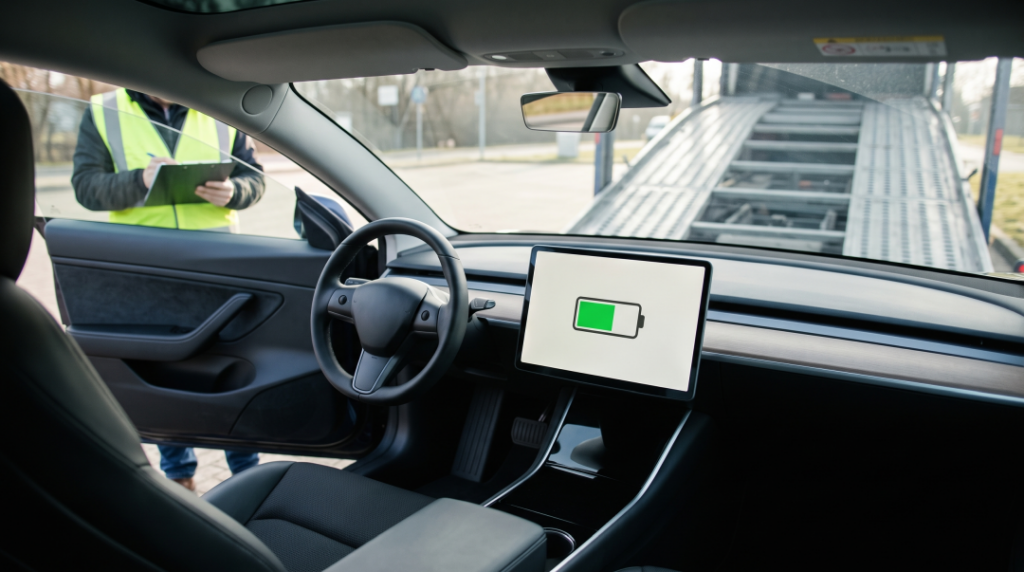
To limit battery drain during transport, turn off features that quietly use power, where your owner’s manual allows it. Sentry Mode, cabin monitoring, scheduled charging, scheduled climate control, and frequent app check-ins all chew through charge while the car sits on a trailer.
Do not count on charging access during vehicle transport. Some specialist operations use mobile Level 2 systems, but you should not assume one will be available during loading and unloading.
Leave enough charge to position the car, unload it, and get you to post-delivery charging. Note the dashboard percentage at pickup and again at delivery. In cold weather, ask your carrier about winterization methods. For an EV that usually means a healthier charge buffer and correct tire pressure. For a gas car, it means checking antifreeze and the battery.
For international shipments, regulated lithium battery cargo is documented under Class 9 Miscellaneous Dangerous Goods. Whether that classification applies depends on the shipment’s condition, configuration, and the transport rules that govern it.
Inspection, Securement, and Insurance
The bill of lading is both your receipt and the condition report. Photograph the exterior, wheels, charge port, any visible underbody areas, the odometer, the charge display, and existing damage at pickup and again at delivery.
Carriers commonly use tie-down straps at the wheels or soft straps where appropriate, following equipment and manufacturer requirements for proper securement. Tell them up front about lowered suspension, aftermarket wheels, underbody damage, or nonstandard towing points.
Read the carrier’s insurance coverage closely: cargo limits, exclusions, deductibles, and the claims process. Then call your own insurer and ask whether your personal auto policy or comprehensive insurance coverage applies during commercial transport. For a car with higher vehicle value, supplemental insurance may be worth the extra cost. Do not assume any single policy covers every loss.
How to Get an Accurate EV or Conventional Car Shipping Quote
Give every company the same details so the quotes actually line up:
Year, make, model, and trim
Trim can change weight and dimensions, so it belongs in every request.Operable or inoperable condition
A car that cannot drive on and off needs a winch or extra labor, and that changes the price.Curb weight, if you know it
Weight decides whether an EV fits on a load without bumping another car off.Vehicle dimensions and modifications
Lifted, lowered, or oversized vehicles can change deck placement and the equipment needed.Battery condition and dashboard warnings
Carriers need to hear about battery issues before dispatch, not at the ramp.Pickup and delivery ZIP codes
Exact locations drive route demand and whether a full-size truck can reach you.Earliest pickup date and acceptable delivery window
Flexible dates give carriers more room to fit your car onto a load.Open, enclosed, flatbed, or container delivery preference
Each option is priced differently, so request the same one from every company.
EV owners should mention low ground clearance, any collision or flood history, battery warnings, and relevant manufacturer instructions before a truck is sent out. Lighter-duty carrier ramps may not suit a heavy or very low car, so the carrier may need different vehicle transport equipment or a modified ramp setup.
International shipments often involve freight forwarders, customs agents, ports, and ocean carriers on top of the road transporter. Find out who handles documents, port moves, and container loading.
Compare total price, not the lowest opening number. Check deposit terms, cancellation policies, pickup windows, possible access charges, insurance documents, and anything that lets the price change later.
Questions to Ask Before Booking
A few practical questions before you say yes:
Does the carrier regularly load this type of EV?
Experience with your model means fewer surprises with weight, clearance, and ramp behavior.What battery charge range do they require?
Get the number in writing and check it against the manufacturer guidance.Is charging during transport available, prohibited, or simply not offered?
Most carriers do not offer it, so plan your charge level around that.How will the vehicle inspection be documented?
Photos and a signed bill of lading at both ends are your evidence if something goes wrong.Does the quote account for weight, inoperability, remote access, and enclosed service?
If it does not, the price can change after you book.What equipment will they use to load safely?
Heavy or low EVs may need different ramps or a flatbed.For container transport, how will the car be secured to the container floor?
Ask about the securing method and who is responsible for it.What documents and deadlines apply to a damage claim?
Claim windows can be short, so learn them before pickup.
Weather, traffic, roadside inspections, port congestion, and carrier scheduling can all shift pickup and delivery dates. Treat delivery as a window, not a promise, unless your written agreement says otherwise.
When to Choose Open or Enclosed Transport
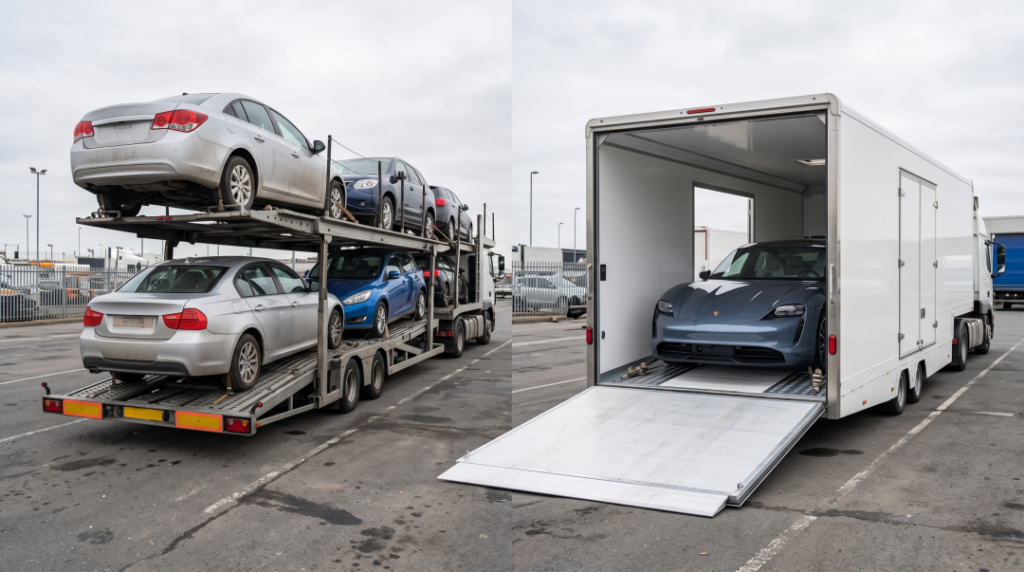
Open transport works for routine, running EVs, hybrids, and gas cars when price is the priority. The car sees ordinary weather, dust, and road debris, about what it would see on the highway anyway.
Enclosed transport gives more protection and suits collector, luxury, brand-new, high-value, or weather-sensitive cars. It also offers a more controlled loading environment. It does not automatically include active temperature management, so ask if that matters to you.
International pricing may add customs brokers, Value Added Tax (VAT), GST, port handling, or other taxes. Duties can also shift depending on trade agreements between the origin and destination countries. None of that depends on whether the car is electric.
Choosing the Right Option for Your Move
Weigh these five things:
Vehicle value and how hard it is to repair
The more a repair would cost, the more enclosed protection is worth.Weather and road exposure along the route
Winter salt, storms, and long highway stretches all add exposure on an open trailer.Operability and ground clearance
A car that cannot drive, or sits low, may need a flatbed or special loading.Timing and carrier availability
Tight windows and busy seasons cost more.Budget and how much risk you can live with
Open transport costs less. Enclosed transport buys peace of mind.
A high-value gas car may need the same premium service as an EV. And a standard running EV does not automatically need enclosed shipping.
For cross-border moves, factor in customs duties, manufacturer guidelines, import eligibility, and where you will charge after delivery. Do not hand over a fully charged car unless the carrier specifically asks for it.
Frequently asked questions
- Does Moving an Electric Vehicle Cost More Than Moving a Conventional Car?
- Sometimes. Battery weight can reduce trailer capacity and raise a carrier’s operating cost. The final quote still depends on distance, vehicle size, route, service type, access, and carrier availability.
- How Does an EV Battery's Weight Affect Auto Transport Trailer Capacity?
- The battery adds to total shipping weight, so the carrier has to stay within trailer payload and axle limits. If the EV keeps another car off the load, capacity, routing, and per-vehicle pricing can all change.
- What Other Differences Affect the Cost of Shipping an EV vs. an ICE Car?
- EV transport may require confirming charge level, battery condition, loading method, and manufacturer guidance. Beyond that, EVs and internal combustion engine (ICE) cars are priced the same way: size, condition, route, transport method, and market demand.
Verdict: Is Moving an EV More Expensive?
Not automatically. Battery mass can raise the rate when it limits trailer capacity or adds handling overhead. Damage, low clearance, special protective materials, or adjusted ramp angles can raise it further, whatever powers the car.
Skip disconnecting the battery unless the manufacturer and carrier specifically tell you to. The best ways to keep costs down: ship a running vehicle, give complete information early, pick the right carrier type, and compare equivalent written quotes.
The Most Useful Comparison Rule
Compare an EV and a gas car of similar size, value, condition, route, and shipping method. Powertrain alone does not set the rate.
Also separate the main carrier charge from driveaway service, import taxes, packaging and handling fees, customs costs, and rampways or loading equipment. A true like-for-like comparison shows whether battery weight is really moving the quote, or whether the difference comes from services and conditions that have nothing to do with the battery.