Door-to-Door vs Terminal-to-Terminal Car Shipping: Which Should You Book?
Door-to-door or terminal-to-terminal car shipping? Compare cost, convenience, and transit times, then see which auto transport option fits your move the best.
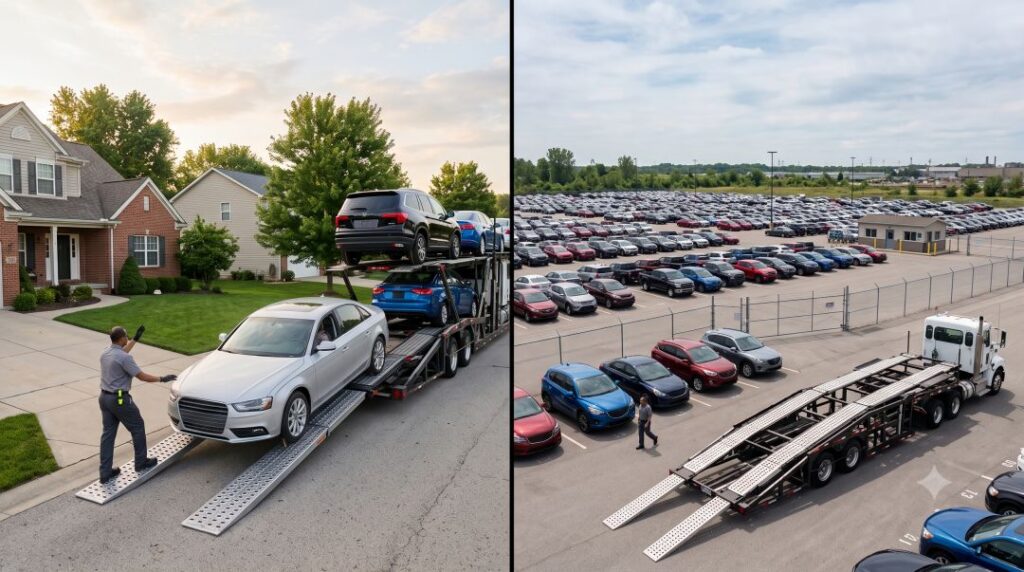
Shipping a car comes down to two questions. First, how does the car get on and off the truck: at your door, or at a terminal? Second, what kind of trailer carries it: open or enclosed? This guide answers the first question in plain language, then shows how the second one changes the math. No jargon, no upsell, just what matters when you book auto transport in the United States. Auto shipping goes by a lot of names, vehicle shipping, vehicle transport, car transport, but the decision below stays the same whatever you call it.
Door-to-door vs terminal-to-terminal car shipping, which should I book?
Short answer: book door-to-door auto transport when time and convenience matter most, and terminal-to-terminal auto transport when you have a flexible schedule and want to trim the shipping cost. Door-to-door removes the legwork. Terminal-to-terminal trades a little of your time for a little of your money. Your address, your schedule, and your vehicle type push the decision one way or the other.
What is door-to-door car shipping?
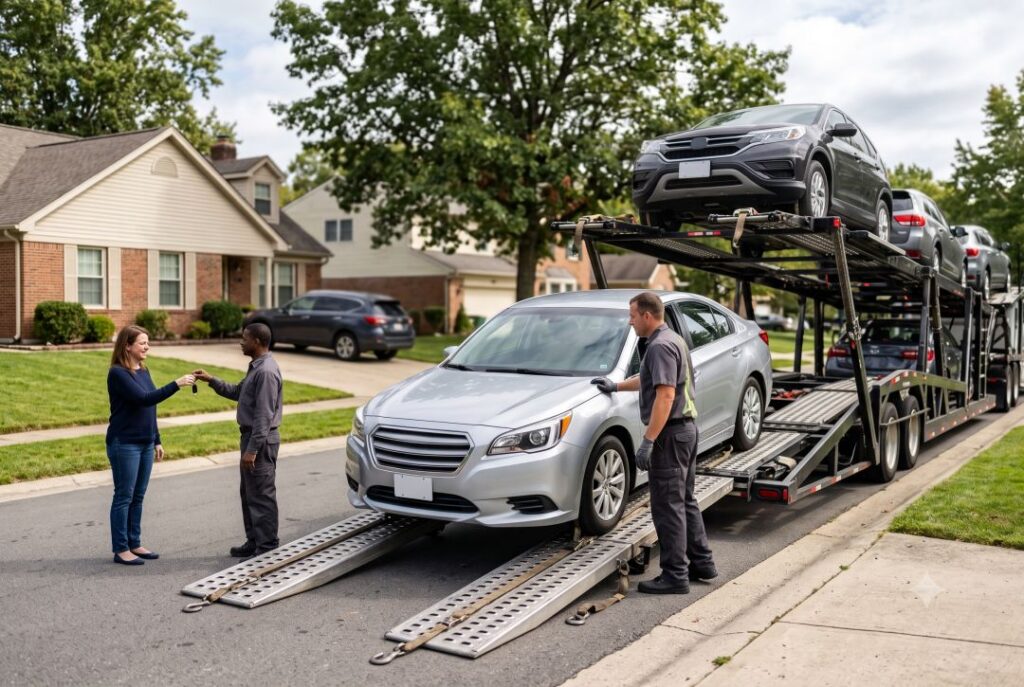
Door-to-door shipping means the auto transporter comes to you. The driver handles pickup at a location you choose, home, office, wherever is convenient, and handles delivery to the destination address. No driving your car across town to a yard, and no arranging additional transportation on either end.
There is one honest caveat, and USA Auto Transport states it plainly on its own pages: car haulers are big. A full-size truck cannot always fit down a narrow street, into a gated community, or up to a downtown area curb. When that happens, the driver arranges a nearby meeting point, usually a large parking lot a few minutes away. That is physics, not a bait and switch.
A few things to know. Someone has to be present for both pickup and delivery to hand over a spare key and complete the vehicle inspection. That person signs the inspection report, also called the Bill of Lading, at both ends. Door-to-door delivery keeps your car on one truck for the whole trip, which means direct routing, reduced mileage of handling, and fewer chances for a scuff. And it is not guaranteed everywhere: availability depends on the pickup and delivery locations and local law.
Door-to-door is the default most people want, and it is the standard behind most online car purchases, long-distance moves, and cross-country moves. The time savings are the main reason people pay a little more. If a hands-off, time-saving move is the goal, this is the one.
What is terminal-to-terminal car shipping?

Terminal-to-terminal car shipping uses regional terminals, secure lots also called an auto transport terminal or automobile terminal, as the drop-off and pickup points. You leave the car at a shipping terminal near you during business hours, the carrier moves it to a transport hub near your destination, and you collect it there.
Here is the mechanism that makes it cheaper. Carriers wait for a full load headed the same direction, then run a direct line between hubs. That route consolidation cuts extra driving, fuel consumption, and labor costs, so the savings get passed to you. Fewer residential detours can also make it environmentally friendlier per vehicle.
The trade-offs are real. You handle the last mile, which can mean extra driving, a ride from a friend, or additional transportation costs that eat into the savings. Terminals offer secure storage, but daily storage fees typically run $25 to $50 per day if you cannot collect the car right away. Short-term storage inside your free storage time is fine. Miss the storage windows and the savings shrink fast. Limited terminal locations are a real constraint too, since not every city has one nearby.
Terminal-to-terminal shines for people with flexible schedules who live near a hub, and for anyone shipping a full fleet at once, since batch loading and unloading is more practical than collecting one car at a time. The flexibility is the whole appeal, and it frees you from having to match window times with a driver.
Door-to-door vs terminal-to-terminal: side by side
| Factor | Door-to-door auto transport | Terminal-to-terminal auto transport |
|---|---|---|
| Pickup and delivery | At your address or a nearby meeting point | At regional terminals you travel to |
| Convenience | Highest, hands-off | Lower, you handle the last mile |
| Base pricing | Slightly higher | Slightly lower |
| Storage fees | None | Daily storage fees after the free window |
| Transit times | Often faster, direct routing | Can be longer, waits for a full load |
| Handling | Stays on one truck | More shuffling between trailers |
| Best for | Busy professionals, families relocating, high-value vehicles | College students, flexible schedules, fleets, budget moves |
| Schedule fit | You must be present at both ends | Drop-off and pickup on your own time, within business hours |
The real cost difference in 2026
This is where most guides are out of date. For years the line was that terminal shipping runs 20 to 30% cheaper than door-to-door. That figure is stale.
Current 2026 reporting puts the real-world gap closer to $150 to $250, or under 15% once you count the fuel, time, and rides needed to reach a terminal. Some sources still cite the older 10 to 20 percent range for the base quote alone, and premium or specialty handling can push certain door-to-door legs 30 to 50% more than a bare terminal rate. For a normal move, the honest takeaway is this: terminal looks cheaper on paper, and sometimes it is not cheaper at all.
Geography decides it. If both ends sit in major cities on interstate corridors, Los Angeles, Chicago, Dallas, Miami, the price difference is small and door-to-door is the obvious call. The cost savings only get real when a pickup or delivery is in rural areas or remote areas, where a direct door run forces the carrier to detour. Route popularity and carrier availability matter too: busy lanes have more trucks, more competitive shipping rates, and lower fuel costs baked in, so they stay cheap either way.
For a ballpark, a standard sedan over 1,000 miles ran about $800 to $1,200 in early 2026, with coast-to-coast closer to $1,400. Those are estimates. Distance, size and weight, make and model, vehicle length, season, and carrier type all move the final number, which is why every serious auto transporter gives you a real quote instead of a sticker price. If squeezing the cost matters most, our guide on the cheapest way to ship a car breaks down every lever you control.
Which method is safer for your vehicle?
Both are safe with a reputable carrier. Door-to-door has a small edge on risk for one reason: less handling. With door-to-door delivery your car loads once and unloads once. Terminal shipping means the vehicle gets parked, moved, and often reloaded between trailers to make space, and every extra touch is a chance for a ding. USA Auto Transport notes on its own open carrier page that roughly 1 in 20 vehicles pick up some cosmetic mark in transit, so cutting handling is not nothing. Whichever you choose, do the vehicle inspection carefully at both ends, photograph the car before pickup, and confirm the insurance coverage. Proper prep matters too, and our checklist on how to prepare your car for shipping walks through it step by step.
Open carrier or enclosed carrier: the other half of the decision
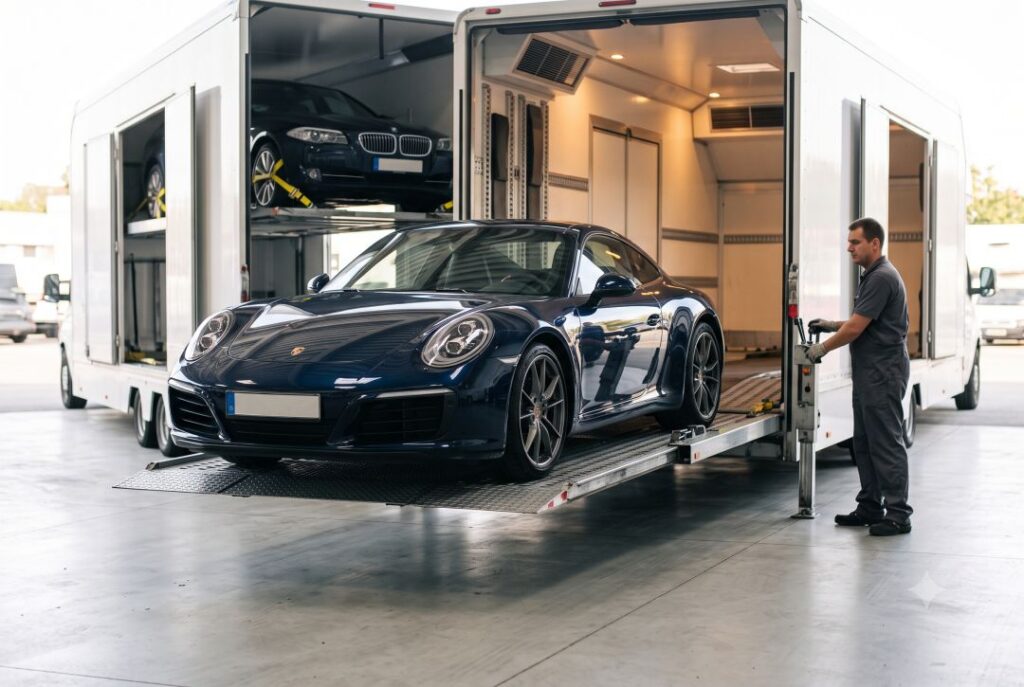
Delivery method is one axis. Carrier type is the other, and you can combine them freely. Open carrier auto transport is the most common and most cost-effective option. Open transport trucks haul up to ten vehicles at once and suit compact cars, sedans, SUVs, and everyday drivers, with coverage up to $100,000. Enclosed trailer auto transport fully covers the car and protects it from weather and road debris. Enclosed transport carries up to four vehicles and is the pick for classic cars, luxury cars, oversized vehicles, exotics, and high-value vehicles, with coverage up to $500,000, a lift gate, and wheel straps for safe loading. So a budget move might be open transport, terminal-to-terminal. A collector shipping a classic across the country would more likely book an enclosed carrier, door-to-door. Mix to fit the vehicle type and the value at stake.
Who should choose which?
Lean door-to-door if you are a busy professional who cannot lose a day driving to a terminal, a family relocating on a fixed timeline, or the owner of a luxury, classic, or high-value vehicle you would rather not hand off twice. It also wins in suburban areas or a gated community, where a short meeting point beats a cross-town terminal trip.
Lean terminal-to-terminal if you are a college student moving between states on a budget, someone with a genuinely flexible schedule who lives near an auto transport terminal, or one of the seasonal travelers running the Northeast to Florida route who plan ahead. It also fits fleet moves, where batch loading is more practical, and active-duty military personnel coordinating a PCS move with shifting dates. Notice that students and military land on the terminal side for budget and the door side for convenience. There is no universal winner, only the winner for your move.
How to book safely and verify your carrier
The shipping method matters less than who you hand the keys to. Auto transport has real fraud in it, and a few minutes of checking prevents most of it. Most companies operate as brokers, coordinating a network of vetted carriers rather than owning every truck. That is normal, and the strength of that carrier network is what determines your experience.
Run the USDOT and MC numbers
Verify credentials: every legitimate auto transporter and auto transport broker must carry a USDOT number and an MC Docket number. Confirm both in the free FMCSA carrier search from the Federal Motor Carrier Safety Administration, and check that the name, address, and phone match. As one example, USA Auto Transport operates under USDOT 3016637.Watch the deposit
Keep it small: a legitimate deposit is roughly 10 to 20 percent of the total and is charged only after a carrier is assigned. Treat a deposit cap in that range as normal, and a demand for 50% or more upfront as a red flag.Refuse untraceable payment
Protect your money: wire transfers, gift cards, and cash apps are how a fraudulent broker disappears. That is textbook internet fraud and a sign of deceptive business practices.Confirm insurance in writing
Ask for proof: request the assigned carrier certificate of insurance and confirm the cargo insurance before you sign.Read recent reviews
Look at the pattern: read the trend across dozens of recent reviews, not just one or two.
USA Auto Transport publishes its USDOT 3016637 number openly, carries up to $500,000 in coverage on enclosed loads, and is BBB listed in Los Angeles, exactly the kind of verifiable footprint you want before booking.
Why ship with USA Auto Transport
USA Auto Transport runs both door-to-door and terminal-to-terminal delivery, on open and enclosed carriers, across a 49-city service network nationwide. Reviewers point to one thing above all: communication. Regular updates by text and call from pickup to drop-off, which is the closest thing to real-time updates most shippers actually need.
Frequently asked questions
- Door-to-door vs terminal-to-terminal car shipping, which should I book?
- Book door-to-door if convenience and speed matter most and you want the carrier to come to you. Book terminal-to-terminal if your schedule is flexible, you live near a terminal, and you want a lower base rate. In major metro areas the cost is close enough that door-to-door usually wins.
- Is terminal-to-terminal really cheaper than door-to-door?
- Usually, but by less than people expect. The 2026 gap is often about $150 to $250, and daily storage fees of $25 to $50 can erase it if you cannot collect the car promptly. Between big cities the difference is often negligible.
- How long does car shipping take?
- USA Auto Transport quotes a guaranteed window of 1 to 14 business days depending on distance. Weather, traffic, and potential delays can extend it, and terminal shipping can add time because carriers wait for a full load.
- Do I have to be present for pickup and delivery?
- For door-to-door, yes: someone must be present at both ends to provide a spare key and sign the inspection report, also called the Bill of Lading. A friend or relative can stand in. Terminal-to-terminal lets you handle drop-off and pickup on your own time, within business hours.
The bottom line
Door-to-door car shipping is the convenient, time-saving pick: the carrier handles pickup and delivery at your address or a nearby meeting point. Terminal-to-terminal car shipping is the budget pick for flexible schedules, with a lower rate offset by potential daily storage fees. In 2026 the difference between them is modest, often $150 to $250, and it shrinks to almost nothing between major cities. Pair either method with an open carrier for affordability or an enclosed trailer for maximum protection, verify any company through the FMCSA, and you will book with confidence. Ready to compare real numbers for your route? Get a free quote and confirm your pickup and delivery windows ahead of time.