How to Ship a Car from Los Angeles to New York: 2026 Guide
Shipping a car from Los Angeles to New York? 2026 costs, transit times, open vs enclosed transport, EV rules, and how to vet a carrier before you book.

Los Angeles to New York is one of the most shipped routes in the country, and one of the easiest to get wrong. Quotes swing by hundreds of dollars, transit estimates vary by a week, and plenty of companies blur the line between a broker and a carrier. This guide covers what the move actually costs in 2026, how long it takes, and how to check a company before you hand over your keys.
How do I ship a car from Los Angeles to New York?
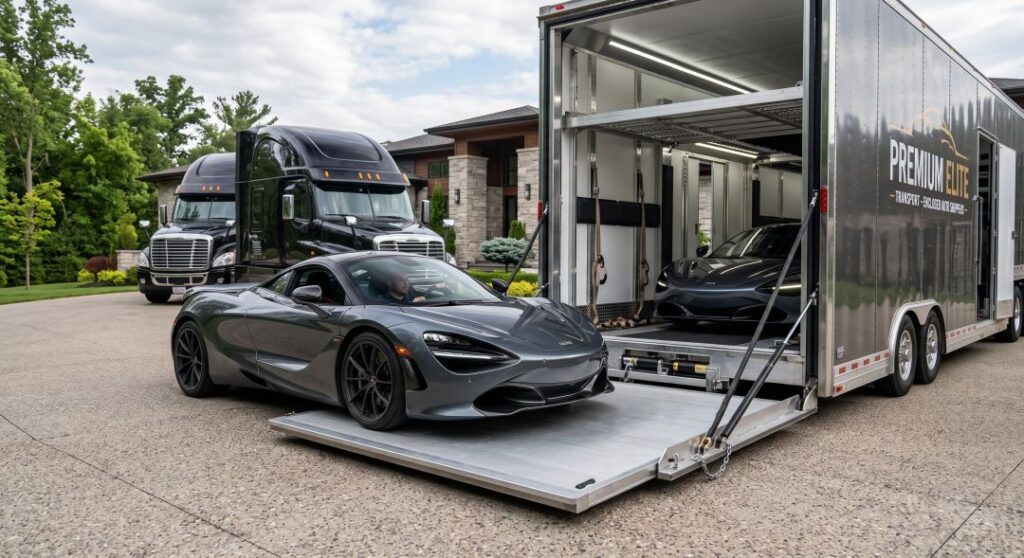
You book a licensed auto transport company, pick open or enclosed transport, hand the car over with a signed Bill of Lading, and wait. The run is about 2,800 miles. Most cars arrive in 7 to 14 days. Open carrier shipping on this lane usually lands around $1,050 to $1,800 in 2026, and enclosed transport runs roughly $1,700 to $2,800.
That’s the whole job. The rest of this guide is about not getting burned while you do it.
Why Los Angeles to New York is its own kind of route
This is one of the busiest car shipping and vehicle shipping lanes in the country, and that’s good news for you. High volume means more carrier availability, which keeps prices competitive and pickup dates reasonable.
Most loads start somewhere in Southern or Northern California. Los Angeles and Long Beach feed a huge share of it. San Diego, San Francisco, Oakland, San Jose, Sacramento, and Fresno all sit on or near the main interstates, so a carrier can grab a car there without a big detour.
On the other end, New York City gets the most trucks, obviously. Upstate is a different story. Albany is usually easy because it sits right on the I-87 and I-90 corridor. Buffalo and Rochester are farther west on the Thruway, and carriers sometimes bundle them with Great Lakes loads instead of Manhattan ones. Expect a slightly longer wait or a small bump in price.
Trucks don’t take one fixed road, either. A driver might run I-40 across the Southwest, cut up I-70 through Denver, or go north on I-80. If the carrier is filling a trailer with Southeast drop-offs, your car could even ride through Atlanta. That’s normal. It’s also why two quotes for the same coast-to-coast transport can differ by several days.
Open vs enclosed transport: choose for the car, not the ego

Open carrier shipping
This is what you see on the highway: a two-level trailer carrying up to nine or ten cars on ramps, held down by wheel straps. It’s the industry default for a reason. The carrier spreads fuel and labor across ten customers, so each one pays less.
The trade-off is exposure. Your car rides outside, in sun, rain, road grit, and whatever the Nebraska wind throws at it. For a daily driver, that’s a car wash at the other end. For a restored ’67 Mustang, it’s a risk you don’t need to take.
Enclosed transport
Hard walls, a roof, and usually two to seven cars per trailer. Good enclosed transport carriers use hydraulic lift gates, which raise the car flat instead of dragging a low front splitter up a steep ramp. They also use soft straps instead of chains on the frame.
Enclosed transport typically costs 30% to 60% more than open. Pay it if you’re shipping classic cars, vintage cars, a lowered or modified build, an exotic, or a car with a paint job you’d cry over. Skip it for a five-year-old Camry. Seriously.
Door-to-door service vs terminal-to-terminal shipping
With door-to-door service, the driver comes as close to your address as a 75-foot rig can legally and safely get. On a tight Brooklyn street or a gated San Francisco hill, that might mean meeting at a grocery store parking lot a few blocks away. Still door-to-door. Just realistic.
Terminal-to-terminal shipping means you drop the car at a lot and pick it up from another lot. It can save money. It can also leave your car sitting in a shared yard for days, and the savings shrink once you add rideshares to and from the terminals. For most people on this route, door-to-door is worth it.
What it costs to ship a car from Los Angeles to New York
Published 2026 route guides put open carrier shipping between roughly $1,050 and $1,800 for a sedan or compact SUV, and enclosed between roughly $1,700 and $2,800. Here is how the options compare.
| Option | Typical 2026 cost (LA to NY) | Transit time | Best for |
|---|---|---|---|
| Open carrier, door-to-door | $1,050 to $1,800 | 7 to 14 days | Daily drivers, most sedans and SUVs |
| Enclosed carrier, door-to-door | $1,700 to $2,800 | 7 to 14 days | Classic, vintage, exotic, and modified cars |
| Terminal-to-terminal | Often slightly less than door-to-door | 7 to 14 days, plus terminal wait | Flexible shippers near a terminal |
| Inoperable vehicle surcharge | About $150 to $200 extra | Adds winch loading time | Cars that can’t start, steer, or brake |
Your shipping cost moves inside those ranges for a handful of reasons.
Vehicle size and vehicle weight
A full-size pickup or a three-row SUV eats more trailer space and more of the truck’s legal weight allowance than a Civic. You pay for that. EVs fall into this bucket too, because the battery pack alone can weigh 900 to 1,300 pounds.Vehicle year and vehicle make
A 1960s classic often needs enclosed handling and careful loading. Some makes have low clearance or odd tie-down points. Tell the company exactly what you’re shipping, including modifications, or the price you were quoted might not be the price you pay.Vehicle condition
If the car can’t start, steer, and brake on its own, the carrier needs a winch. Expect an inoperable fee, often somewhere around $150 to $200.Seasonal demand and peak season
Summer is peak season. Families move between school years and rates climb. Late fall and early spring bring the snowbird rush on north-south lanes, which pulls trucks off cross-country work and can tighten carrier availability here too.Weather conditions
Winter storms on I-80 and I-70 slow everything down. Drivers price in that risk, and so should your timeline.A flexible schedule
This one’s underrated. If you can give the company a three to five day pickup window instead of one fixed pickup date, you often get a better rate, because the dispatcher can fit your car onto a truck that’s already heading east.Broker fees
Most companies you’ll talk to are brokers, not carriers. The broker finds a truck and takes a cut, which is built into your quote. That’s fine and completely normal. Just know it’s there, and ask how it’s charged.
A word on the instant quote
An instant quote from an online calculator is an estimate, not a contract. It’s useful for a ballpark. It is not what you’ll pay if the market moves before a truck commits to your car. The only number that matters is the one in writing, with the terms attached.
How to compare car shipping companies without getting played
This is the part most guides skip. Here’s how to do it right.
Get three or four quotes on the same terms
Same pickup date window, same transport type, same vehicle details. Otherwise you’re comparing different products and calling it price shopping.Ask what the deposit actually does
Some companies take no money until a carrier is assigned. Others take a deposit up front. Ask whether it’s a refundable deposit, and under what conditions. If the answer is vague, that’s your answer.Ask if the price is locked
Some companies lock it. Sherpa Auto Transport, for example, markets a Price Lock Promise that caps how much the price can move after booking. Others quote into the live market and can come back asking for more if trucks are scarce. Neither model is a scam. They’re different products. Know which one you’re buying.Ask about price matching, but read the fine print
Price matching usually means the company will match a competitor’s written quote. That’s not the same as guaranteeing your final bill.Ask how tracking works
Real-time tracking means different things at different companies. Some offer live GPS tracking of the truck. Others give you a dispatcher who calls the driver and updates you. Both can work. You just want to know which one you’re getting before your car is in Oklahoma and you’re refreshing your email.Read independent reviews, not just testimonials
Third-party sites like FreightWaves Checkpoint and TransportVibe publish route cost guides and company reviews you can cross-check against. Keep in mind some review sites also run their own brokerage or sell placements, so read their disclosures.
You’ll probably see names like Sherpa Auto Transport, Navi Auto Transport, RoadRunner Auto Transport, Nexus Auto Transport, A1 Auto Transport, and Mercury Auto Transport show up in your search results and on those review sites. Run every one of them, and us, through the same checks. The company that answers these questions clearly and in writing is usually the one worth booking.
Safety, licensing, and who’s actually liable
Check the FMCSA database first
Every legitimate interstate auto transport company has a USDOT number, and most have an MC number. Look them up on the FMCSA SAFER system before you pay a cent. You’re checking three things.
Is the authority active?
Not revoked, not out of service.Carrier or broker?
“Motor carrier” means they can run trucks. “Broker” means they arrange the truck.Power units
Zero power units means zero trucks. That’s normal for a broker. It’s a red flag for a company claiming to run its own fleet.
The FMCSA also runs a consumer campaign called Protect Your Move, which covers the classic scams. The ugly one is the “hostage load,” where a company demands extra cash at delivery before it releases your property. Don’t book with anyone who won’t put the total price in writing.
Driver hours are regulated, which is why transit takes a week
Truck drivers can’t just drive straight through. FMCSA Hours of Service rules cap them at 11 hours of driving after 10 consecutive hours off duty, inside a 14-hour on-duty window. There’s also a weekly cap of 60 hours over 7 days or 70 over 8. Electronic Logging Devices plugged into the truck’s engine record all of it automatically.
That’s the real reason a 2,800-mile run takes 7 to 14 days and not four. It’s also the reason you want those rules enforced. A tired driver hauling ten cars is nobody’s friend.
The Bill of Lading is your evidence
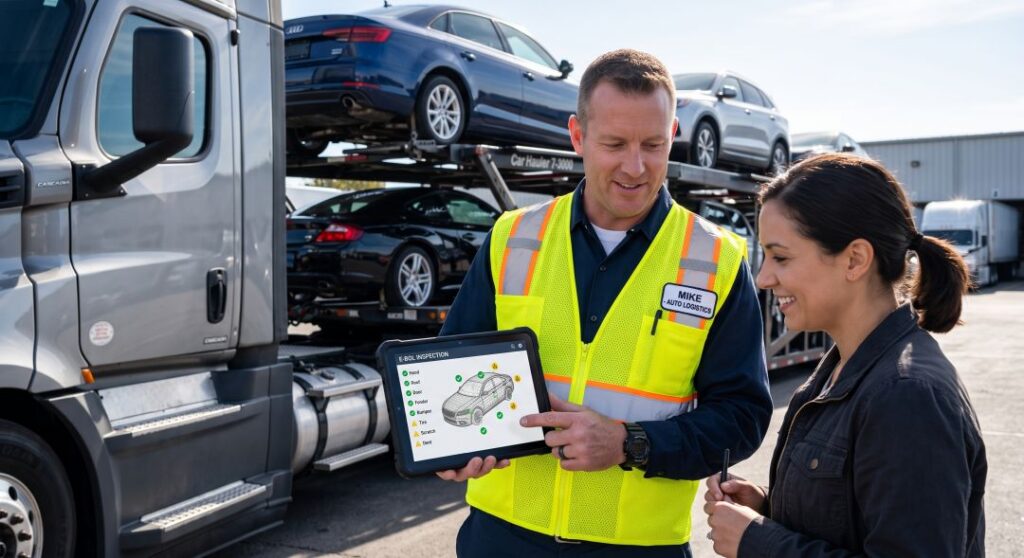
The Bill of Lading does three jobs at once: receipt, contract, and condition report. At pickup, you and the driver walk the car together and mark every scratch, chip, and dent on it. At delivery, you do it again before you sign.
Take your own photos too. Timestamped, in daylight, every panel, the wheels, the roof, the odometer. Most carriers now use an electronic Bill of Lading with photos built in, which helps. Yours are backup.
Here’s the thing people miss: if you sign the delivery Bill of Lading without noting damage, you’ve basically said the car arrived fine. Take your time. The driver can wait ten minutes.
The Carmack Amendment and insurance coverage
Interstate cargo damage falls under the Carmack Amendment (49 U.S.C. § 14706), a federal law dating back to 1906. It holds the carrier liable for damage that happens while your car is in its custody. You don’t have to prove the driver was careless. You have to show the car went on the truck in one condition and came off in another. That’s exactly what the Bill of Lading proves.
There are exceptions: acts of God, acts of public enemies, inherent defects in the car itself, and anything caused by the shipper. And carriers can limit their liability through the rates they offer, so don’t assume. A few practical points on insurance coverage:
Ask for the certificate of insurance
Get it before pickup. Then check it against what’s filed with the FMCSA.Ask for the per-vehicle limit
An open trailer’s cargo policy is often per load, not per car. Ten cars share it.Know which carrier got assigned
If you’re booking through a broker, the carrier’s cargo policy is what actually covers the car.Don't count on coverage for personal items
Auto carriers aren’t licensed to haul household goods, and anything you leave in the cabin generally isn’t covered.Don't wait on a claim
Carmack doesn’t let carriers set a claim deadline shorter than nine months, but that’s the floor, not a suggestion. File as soon as you find damage.
Shipping an electric vehicle coast to coast
EVs need a little more thought.
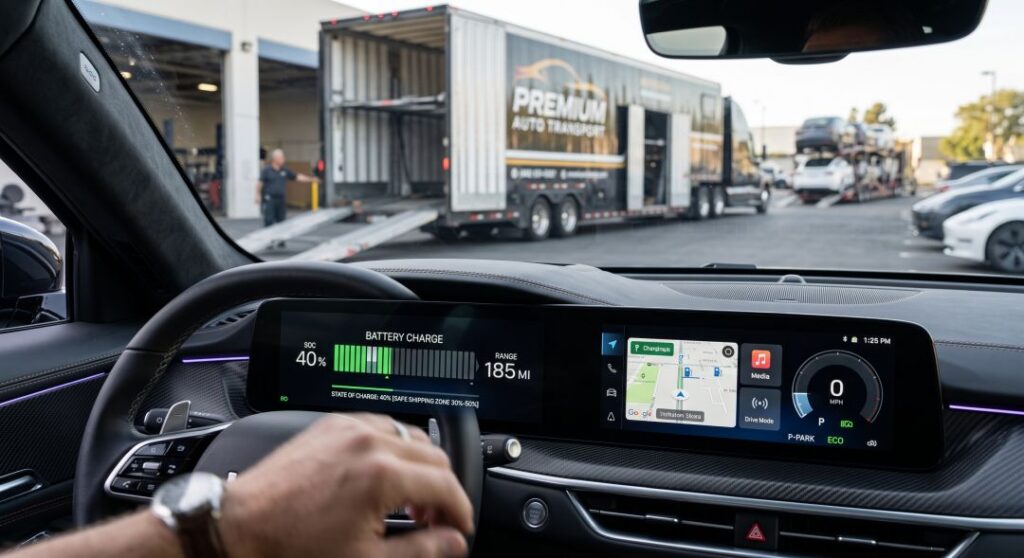
Charge to about 30% to 50%
Most carriers and manufacturer transport guidance point to a partial charge. It leaves enough juice to drive on and off the trailer while keeping the battery in a calmer state than a full 100%. Some carriers will turn away an EV that’s at a full charge, so ask ahead.Turn off Sentry Mode and similar features
Tesla’s Sentry Mode, and camera or motion alarms on other EVs, will trigger over and over from the trailer’s movement. That can drain the 12V battery and chew through the main pack. Cars have arrived in New York completely dead because of it. Check whether your model has a dedicated transport or tow mode too.Tell the company it's an EV
The extra weight changes how the carrier loads the trailer. It can also affect which truck they assign.
How to prepare your car for pickup
Work through this list a day or two before the driver arrives. There’s more detail in our car shipping preparation guide.
Wash it
Do it a day or two before, so you can actually see the paint during inspection and the vehicle condition report is accurate.Photograph everything
Inside and out, plus the odometer.Leave a quarter tank or less
Enough to load and unload. Less weight, less risk.Clear out personal items
Some companies allow a small amount in the trunk. Ask first.Remove toll tags
Or you might pay for every bridge between Los Angeles and New York.Disable alarms
Or set them to transport mode.Check tires, fluids, and the parking brake
Note any leaks for the driver.Hand over one key set
Keep a spare.
Should you just drive it yourself?
Maybe. Some people love the road trip. But run the actual numbers first.
Driving LA to New York is 40 to 45 hours behind the wheel if nothing goes wrong. Realistically, that’s five to seven days once you add sleep and stops. Add hotels, meals, gas, and tolls, and you’re often close to the price of shipping. Then add nearly 3,000 miles to the odometer, an oil change, some tire wear, and a week of your life.
| Drive it yourself | Professional auto transport | |
|---|---|---|
| Your time | 5 to 7 days, about 40+ hours driving | Under an hour for pickup and delivery |
| Transit time | 5 to 7 days | 7 to 14 days |
| Miles added | About 2,800 | Zero |
| Costs | Fuel, hotels, food, tolls, wear | One quoted price (confirm what’s included) |
| Risk | Weather, fatigue, breakdowns, accidents | FMCSA-regulated driver, carrier cargo coverage |
| If something breaks | Your problem | Carrier’s liability under Carmack |
If you’re flying to New York anyway, shipping almost always wins. If the drive is the point, go enjoy it.
Why choose USA Auto Transport for your Los Angeles to New York move
We’re a Los Angeles based auto transport company, licensed under US DOT 3016637 and MC-32073. You can look us up on the FMCSA database right now. We’d actually prefer you do.
We’re registered as a broker, and we’re upfront about it. That means we don’t drive the truck ourselves. We place your car with vetted open and enclosed carriers that run this lane every week. Here’s what you get from us.
Door-to-door service
From anywhere in California, from San Diego to Sacramento, to New York City, Long Island, and upstate.Open and enclosed transport
Including enclosed trailers with lift gates and soft tie-downs for classic cars, exotics, and EVs.Published insurance coverage
Up to $100,000 on open carriers and up to $500,000 on enclosed carriers for external damage.A confirmed pickup and delivery window
Based on your route and mileage, confirmed before you pay.Shipment tracking
Through your coordinator, who stays in touch with the driver the whole way. See how shipment tracking works.Alaska and specialty routes
When your move doesn’t fit a standard truck lane, including Alaska car transport.
Ask us the same questions you’d ask anyone else. Get it in writing. Then decide.
Frequently asked questions
- How do I ship a car from Los Angeles to New York?
- Book an FMCSA-licensed auto transport company, choose open or enclosed transport, and pick door-to-door or terminal-to-terminal service. At pickup, inspect the car with the driver and sign the Bill of Lading. Most shipments on the 2,800-mile route take 7 to 14 days, and open transport usually costs about $1,050 to $1,800 in 2026.
- How long does it take to ship a car from Los Angeles to New York?
- Most shipments take 7 to 14 days from pickup to delivery on the 2,800-mile run. Winter weather on I-80 and I-70, a remote pickup, or an upstate drop-off like Buffalo or Rochester can push it toward the longer end. Federal hours of service rules also limit how far drivers can go each day.
- How much does it cost to ship a car from California to New York?
- In 2026, open carrier shipping from Los Angeles to New York typically runs about $1,050 to $1,800 for a sedan or small SUV. Enclosed transport usually costs $1,700 to $2,800. Vehicle size, weight, condition, season, and how flexible your pickup date is all move the final shipping cost.
- Is my car insured during transport?
- Yes. Licensed carriers must carry cargo insurance, and the Carmack Amendment holds them liable for damage while your car is in their custody. Ask for the certificate of insurance before pickup, confirm the per-vehicle limit, and note every existing mark on the Bill of Lading so any claim is easy to prove.
- Can I pack personal items in my car?
- Mostly no. Auto carriers are not licensed to move household goods, and items left in the car usually are not covered by the carrier’s insurance. Some companies allow a small amount in the trunk. Ask before you pack, and never leave valuables, documents, or anything you can’t replace.
- How do I prepare an electric vehicle for shipping?
- Charge the battery to about 30% to 50%, disable Sentry Mode or any motion-triggered camera and alarm systems, and check whether your model has a transport mode. Tell the company it’s an EV when you book, because the extra weight affects how the carrier loads the trailer.
- Should I choose open or enclosed transport?
- Open carrier shipping is the smart pick for most daily drivers. It’s cheaper and trucks are easier to book. Choose enclosed transport for classic cars, vintage cars, exotics, low-clearance or modified cars, or anything with fresh paint. It typically costs 30% to 60% more, but the car rides fully protected.
The bottom line
Shipping a car from Los Angeles to New York comes down to three things: check the license, get the price and terms in writing, and document the car on the Bill of Lading at both ends. Do that and a 2,800-mile move becomes a boring logistics job, which is exactly what you want. Tell us what you’re shipping, when you need it picked up, and where it’s going, and we’ll give you a straight number and a straight answer on what it includes. Get a free quote from USA Auto Transport or call 323-524-0031.