Best Company to Ship a Car From Texas to California 2026
Shipping a car from Texas to California in 2026? Compare five auto transport companies, real open and enclosed price ranges, transit times, and prep steps.
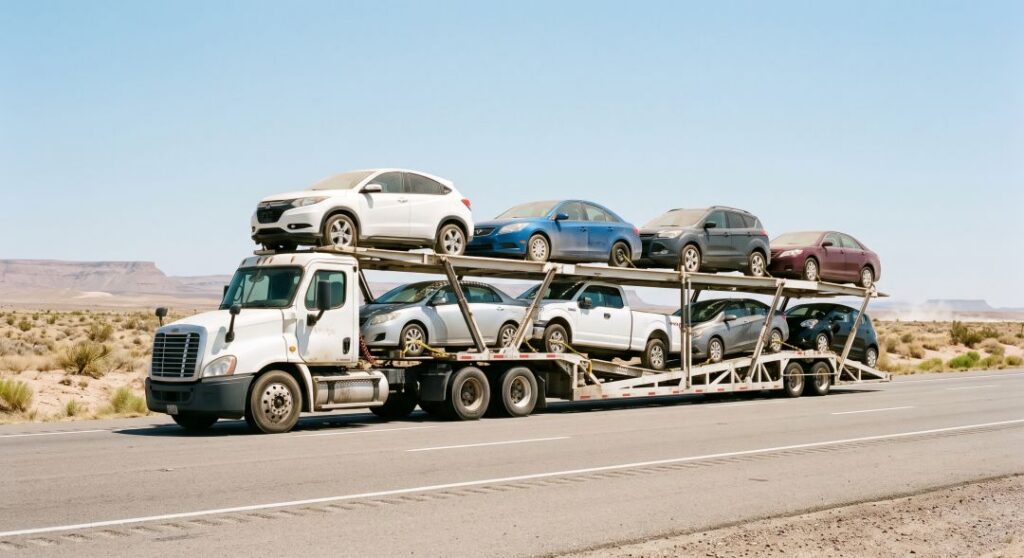
Texas to California is one of the busiest vehicle shipping lanes in the country, and it is also the quieter half of a two-way migration. Most of the volume, the headlines and the moving trucks run the other way. That imbalance is the single most useful thing to understand before you book, because it shapes what you pay and how fast a carrier turns up.
This guide compares five car shipping companies on this specific route, sets out real 2026 price ranges by city pair, walks the logistics from booking to delivery, and covers two California rules that catch new arrivals off guard.
The 5 best companies to ship a car from Texas to California
Every company below is ranked on what it actually does well on this lane rather than on advertising spend. The criteria are corridor coverage at both ends, published federal licensing, stated insurance limits, transport options, and how transparent the pricing process is.
USA Auto Transport: our recommended pick for the Texas to California corridor
FMCSA: MC#320733, USDOT 3016637. Coverage: Austin, Dallas, Houston and San Antonio in Texas; Los Angeles, San Diego, San Francisco, San Jose, Sacramento, Santa Ana, Santa Monica, Santa Barbara, Santa Cruz, Palm Springs and Palo Alto in California.
A licensed property broker that arranges transport through vetted, FMCSA-compliant carriers rather than running an in-house fleet. You get open transport and enclosed transport, door-to-door service subject to availability and local road rules, and terminal-to-terminal where the carrier network supports it. External damage coverage runs up to $100,000 on open carriers and up to $500,000 on enclosed. Inoperable vehicles ship for an added fee provided the emergency brake holds, the tires are inflated and the steering turns.
What earns it the top slot here is density at both ends of this particular lane. Both the pickup metros and the delivery metros are covered by dedicated city pages and local dispatch, which matters more on a route where carrier availability, not price, is usually the constraint. The published delivery window is 1 to 14 business days scaled to mileage, and up to 100 lbs of personal items may travel in the trunk. The full range of vehicle shipping services also includes household moving, so a family relocating a home and a car books once rather than twice.Sherpa Auto Transport: price certainty
Sherpa built its reputation on locking the quoted price so the figure you agree to is the figure you pay, which addresses the oldest complaint in this industry: a low quote followed by a mid-transit increase. Its published range for Texas to California is $850 to $1,250 on an open carrier. Sherpa also flags something most competitors leave out, which is that California equipment rules mean not every carrier is licensed to enter the state. Fewer specialty vehicle options than the larger brokers.SGT Auto Transport: lowest published range on the lane
SGT publishes a Texas to California range of $799 to $999, the lowest of the five, and covers a broad spread of standard and non-standard vehicle types. Treat the low end as a starting point rather than a promise, because published ranges on this route assume a running sedan moving metro to metro with flexible dates. Confirm your specific vehicle class before booking rather than assuming it is included.AmeriFreight: structured discount programs
A long-established broker with formal discounts for active-duty and retired military, first responders, medical personnel, students and seniors. If you fall into one of those groups the savings are real and they stack better than the ad hoc discounting most brokers offer. AmeriFreight reports a BBB rating of 4.81 out of 5 from 671 reviews as of July 2026. Note that its own published pricing for this lane is inconsistent across pages, so get the number in writing.RoadRunner Auto Transport: volume on busy lanes
One of the larger national brokers, with more than 20 years on the road and the carrier volume to move standard vehicles on high-traffic corridors without a long wait. It publishes a wide Texas to California range of $800 to $1,900 open and $1,000 to $2,400 enclosed, and also publishes useful aggregate shipment data, including a 2026 national average of $1,215 and a median rate of $1.23 per mile. Less compelling for rural pickups.
Why USA Auto Transport ranks first on this route
The honest case is not that it is the cheapest. On published ranges it is not. The case is coverage density on both ends of this lane, transparent federal licensing you can check yourself in under a minute, and clearly stated insurance limits. On a corridor where the real risk is a carrier not showing up on the day you need, those matter more than fifty dollars.
How much car shipping from Texas to California costs in 2026
Expect roughly $850 to $1,400 for open transport on a standard sedan, and about 30 to 40 percent more for an enclosed trailer. The corridor runs between 800 and 1,750 miles depending on which city pair you are moving, so the spread inside that range is wide and mostly driven by distance.
| Route | Approx. miles | Open transport | Enclosed transport | Transit time |
|---|---|---|---|---|
| El Paso to Los Angeles | 800 | $600 to $900 | $850 to $1,300 | 2 to 4 days |
| San Antonio to Los Angeles | 1,350 | $800 to $1,250 | $1,150 to $1,800 | 3 to 5 days |
| Austin to Los Angeles | 1,375 | $825 to $1,275 | $1,175 to $1,850 | 3 to 5 days |
| Dallas to Los Angeles | 1,435 | $850 to $1,300 | $1,200 to $1,900 | 3 to 5 days |
| Houston to San Diego | 1,470 | $875 to $1,350 | $1,250 to $1,950 | 3 to 6 days |
| Houston to Los Angeles | 1,550 | $900 to $1,400 | $1,300 to $2,000 | 3 to 6 days |
| Dallas to San Francisco | 1,730 | $975 to $1,500 | $1,400 to $2,150 | 4 to 7 days |
Run the per-mile math and these numbers look reasonable rather than optimistic. A $900 open shipment across 1,500 miles works out to about 60 cents a mile. National benchmarks put typical car shipping rates between 61 cents and $2.00 per mile, with long hauls sitting at the bottom of that band because the fixed costs spread across more miles. Analysis of roughly 800 quotes by Move.org puts the average continental crossing near $1,128. A long lane like this one should price near the floor per mile, and it does.
Six things move your number, roughly in order of how much control you have over them. Vehicle size and length comes first: an average sedan runs about 189 inches, and anything under that loads more easily and prices better than a lifted truck or a long SUV. Then open or enclosed, then time of year, since demand peaks between Memorial Day and Labor Day. After that, metro versus rural at each end, date flexibility, because a fixed pickup date costs more than a window, and finally fuel prices, which nobody controls.
Why the same corridor costs different amounts in each direction
This is the part almost nobody explains. Carrier demand on this lane is not balanced. The population flow runs California to Texas, which means trailers heading west are frequently the return leg, and a return leg with empty slots prices differently from a full one.
You can see it in published pricing. One national broker lists California to Texas at $1,050 to $1,425 and Texas to California at $850 to $1,250, the same corridor and the same company, a couple of hundred dollars apart. Another broker publishes the gap running the opposite way. So the asymmetry is real but not uniform, and the practical lesson is simple: never assume a quote you saw for the reverse trip applies to yours. If you are researching the other direction as well, our complete guide to California to Texas car shipping covers that side, and the Bay Area to Austin relocation route is the specific version of it that most tech transplants are actually running.
The upside for you: westbound flexibility is worth more money on this lane than on a balanced one. Giving a shipping coordinator a three or four day pickup window instead of a single date is the cheapest discount available.
How long does Texas to California car shipping take?
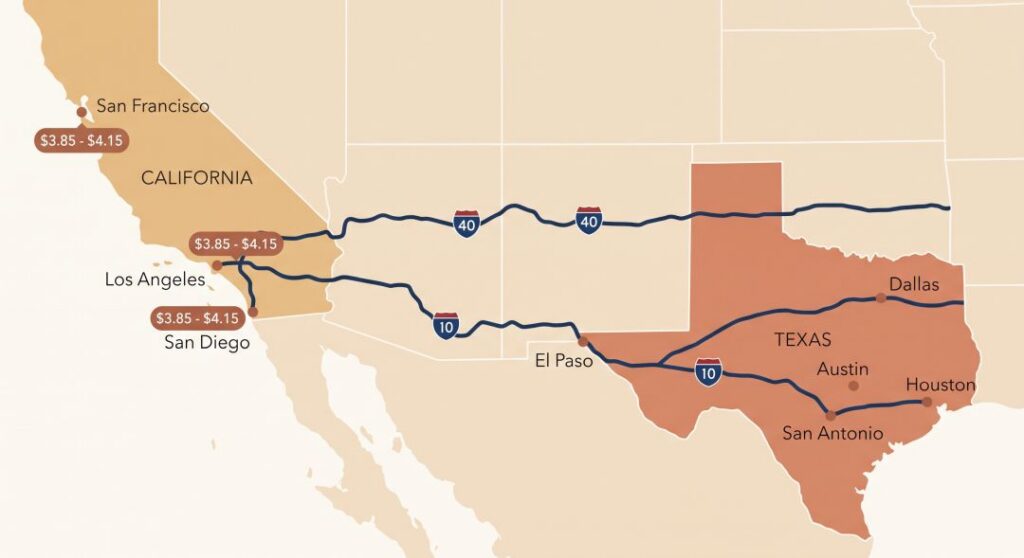
Most vehicles on this lane move in three to six days once a carrier collects them, plus one to three days for a carrier to be assigned. A realistic end-to-end expectation from booking to delivery is five to nine days.
USA Auto Transport publishes a delivery window of 1 to 14 business days scaled to mileage. That is wider than the transit estimates above and deliberately so. A broker contracts to a window it can hold in bad weather and heavy traffic, not to the best case. Treat the published window as the commitment and the three to six days as the likely outcome. Full policy detail sits on the car shipping FAQ.
Federal hours-of-service rules cap how long a driver can operate in a day, which is the real reason a 1,500 mile run is not an overnight trip. Most carriers on this corridor route along I-10 through the southwestern desert or take I-40 west out of North Texas, then drop south toward Los Angeles and San Diego.
Open transport or enclosed transport on this route
Open transport is the right answer for the large majority of vehicles. Enclosed transport earns its premium on a specific short list: classic cars, luxury vehicles, exotics, anything with fresh paint, and anything whose value makes any risk unacceptable.
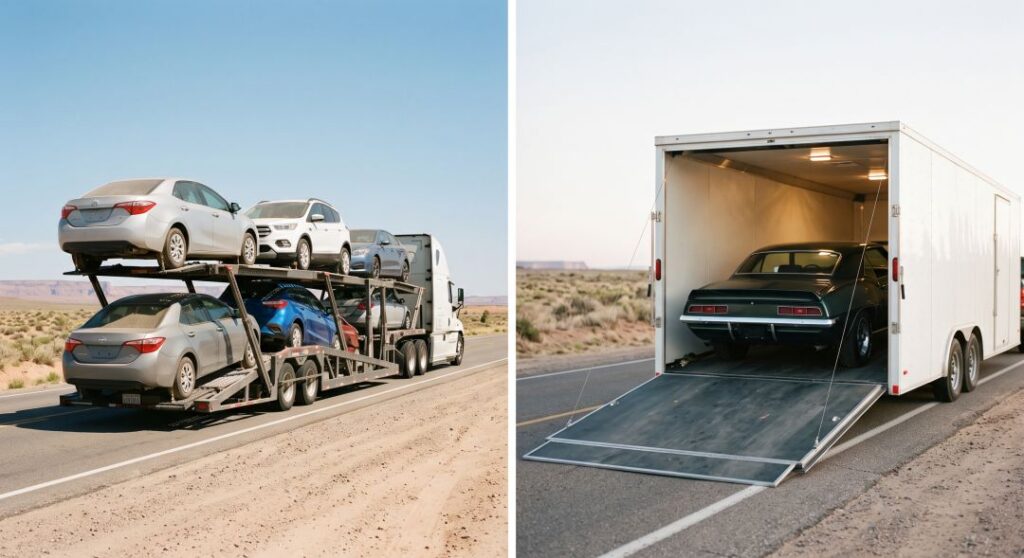
| Factor | Open transport | Enclosed transport |
|---|---|---|
| Cost on this lane | Baseline | Roughly 30 to 40 percent higher |
| Carrier availability | Wide, short waits | Limited, expect to wait longer |
| Damage coverage | Up to $100,000 | Up to $500,000 |
| Weather and road debris | Vehicle is exposed | Fully enclosed trailer |
| Vehicles per load | Up to nine on a multi-car trailer | Far fewer, often one to three |
| Best suited to | Sedans, SUVs, trucks, daily drivers, electric vehicles | Classic car, luxury vehicles, exotics, fresh paint |
One route-specific note on the open option: the I-10 desert stretch is hot, dusty and hard on paint in a way that Pacific Northwest rain is not. It will not damage a sound vehicle, but it will arrive dirty. Budget for a wash rather than for an enclosed trailer unless the vehicle genuinely warrants one.
The logistics: how a Texas to California shipment actually runs
Booking. You give pickup and delivery ZIP codes, the year, make and model, whether the vehicle runs, and your date flexibility. A shipping coordinator returns a free estimate. There is no calculator that spits out a number, which is slower than some competitors and also why the quoted figure tends to survive contact with reality.
Carrier assignment. The broker posts your load to its carrier network and matches it to an FMCSA-compliant auto hauler already running the lane. This is the step that takes one to three days and the step that flexibility shortens. Payment is collected in full one business day before pickup, by credit or debit card.
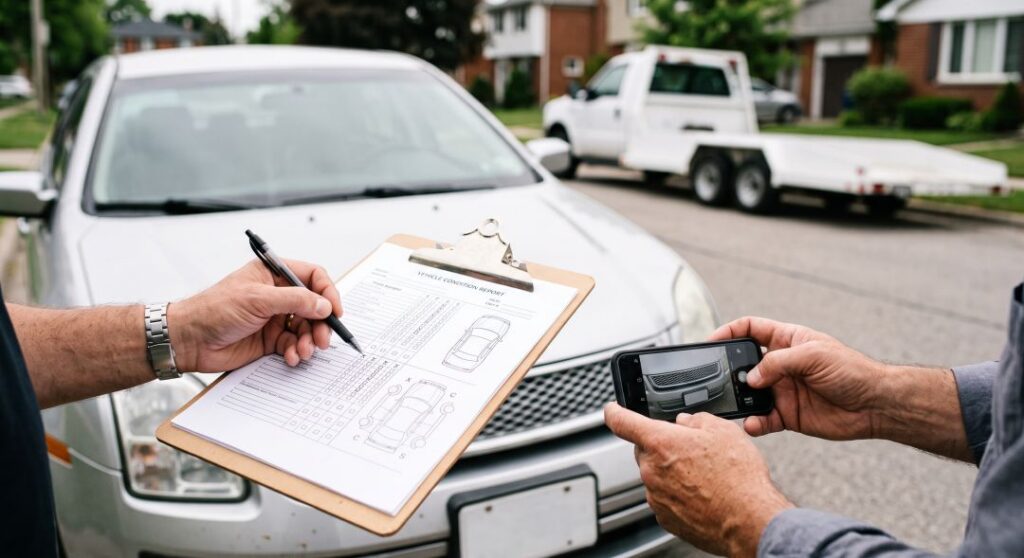
Pickup. The driver walks the vehicle with you and records every existing mark on the bill of lading. That document is both the contract and the damage baseline, and it is the only thing a later claim gets measured against. Someone over 18 must be present, hand over a spare set of keys and sign. A friend or relative can stand in for you.
In transit. Status comes from your shipping coordinator by phone. There is no customer-facing GPS map or tracking app, and any company that promises live satellite tracking on a third-party carrier is describing something the driver, not the broker, controls.
Delivery. Expect a call 12 to 24 hours out to arrange the drop. Commercial trailers run 75 to 80 feet, so if your street is narrow or has low branches, the driver will nominate a nearby handoff point, usually an open shopping center lot. Inspect against your own photographs before you sign anything. Damage noted after the driver leaves is far harder to claim.
How to prepare your vehicle for pickup
None of this takes long, and skipping the photographs is the single most common expensive mistake.
Wash it first
Damage documentation is only as good as the paint you can see. A dirty car makes the pickup inspection worthless.Photograph everything, timestamped
Every panel, both bumpers, all four wheels, the roof and the odometer. This is your evidence and it belongs to you, not to the carrier.Leave one eighth to one half a tank
A full tank is dead weight that costs money to haul and adds risk. Anything in that band is fine.Remove the toll transponder
A TxTag, TollTag or EZ TAG will keep reading from the deck of a trailer and quietly bill you across two states.Keep personal items to 100 lbs, trunk only
Nothing in the cabin. Personal belongings are not covered by cargo insurance, so keep it to soft goods and nothing you would miss.Charge electric vehicles to 30 to 50 percent
Enough for loading and unloading without hauling a full battery. Electric vehicles also weigh more, which is reflected in the quote.Strip anything loose
Roof racks, spoilers, aerials and bike carriers. If it can catch wind at highway speed, take it off.Disable the alarm
Or hand over clear instructions with the keys. A siren going off in a truck stop at 2am does nobody any favors.
Not every truck can legally enter California
California regulates which heavy-duty vehicles may operate on its roads, and the rules apply to out-of-state trucks. The CARB Clean Truck Check program requires subject vehicles to report, pay an annual compliance fee and pass emissions testing, currently twice a year. Enforcement runs through roadside monitoring, remote emissions devices, plate readers and California Highway Patrol inspections, and non-compliant vehicles can be refused entry at ports and railyards.
There is an active federal dispute over it. In January 2026 the EPA partially disapproved the state plan as it applies to out-of-state trucks. CARB restated in March 2026 that the program remains in force for every vehicle operating in California regardless of where it is registered, and that the federal decision affects emissions credit accounting rather than enforcement. Whatever the litigation eventually decides, the operational reality today is unchanged.
Why this matters to you rather than to a fleet manager: it thins the pool of Texas-based carriers legally able to complete the delivery leg. It is a fair question to ask before you book, and a good auto transport company will have an answer ready.
The 20 day clock that starts when you arrive
New California residents have 20 days to register an out-of-state vehicle, and penalties begin on day 21. The clock is tied to residency, not to your moving date and not to when the car arrives.
Residency is intent-based. Accepting a job in California, enrolling a child in school, registering to vote or claiming a homeowner exemption all start it, whether or not you have changed your license. The California DMV new resident guidance sets out the full list.
Three things catch Texas arrivals in particular. California does not accept out-of-state smog certificates, so a fresh Texas inspection buys you nothing and you will need a California smog check. The newer-vehicle smog exemption does not apply to a vehicle being registered here for the first time. And a VIN verification is required, which means the transaction happens in person at a DMV office rather than online. A separate 10 day deadline applies to converting your driver license.
The scheduling consequence is the useful bit. If your registration clock starts the day you take the job in San Diego while your vehicle is still on a trailer somewhere near El Paso, you are burning days you cannot recover. Book pickup around your residency date, not your move-out date.
How to check any auto transport company in ninety seconds
This works for every company on this page and every one that is not. Learn the method rather than trusting a list.
Ask for the USDOT number and the MC number
Any legitimate operator publishes both. A company that will not give you them on request has answered your question.Look them up on FMCSA SAFER
The Safety and Fitness Electronic Records system is the official federal database and the Company Snapshot is free. No account needed.Match the legal name
The registered name on the federal record should match the name on the website and on your contract. Stolen USDOT numbers are a known scam pattern, and a mismatch is the tell.Check whether the authority is broker or carrier
A broker arranges transport through a network of auto haulers. A carrier owns the trucks. Both are entirely legitimate and the distinction changes who is holding your vehicle. A company that dodges the question is the problem.Read the complaint history
FMCSA keeps a public complaint database tied to the same number. Two minutes there is worth more than an hour of reading reviews.
USA Auto Transport publishes USDOT 3016637 in the footer of every page on the site, which means you can run this check on us before you finish reading this sentence.
Frequently asked questions
- How much does it cost to ship a car from Texas to California?
- Budget roughly $850 to $1,400 for open transport on a running sedan, depending on the city pair and the time of year. Enclosed transport runs about 30 to 40 percent higher. Shorter runs such as El Paso to Los Angeles start near $600, while Dallas to San Francisco can reach $1,500 on an open carrier. SUVs, trucks and electric vehicles cost more than sedans because of weight and length.
- How long does Texas to California car shipping take?
- Most vehicles arrive three to six days after collection, with one to three days beforehand for a carrier to be assigned. USA Auto Transport publishes a delivery window of 1 to 14 business days scaled to mileage, which is the contracted commitment rather than the expected outcome. Federal hours-of-service limits on drivers are the reason a 1,500 mile run takes several days.
- Do I need enclosed transport for the desert crossing?
- Usually not. Heat and dust on the I-10 corridor will make the vehicle arrive dirty but will not harm a sound car, and a wash on delivery costs a great deal less than the enclosed premium. Choose an enclosed trailer for a classic car, a luxury or exotic vehicle, fresh paint, or anything where you are unwilling to accept any risk at all.
- How soon do I have to register the car once it reaches California?
- New residents have 20 days from establishing residency to register an out-of-state vehicle, and the clock is tied to residency rather than to the arrival of the car. California does not accept out-of-state smog certificates, so you will need a California smog check plus a VIN verification, and both require an in-person DMV visit. Converting your driver license carries a separate 10 day deadline.
Key takeaways
Texas to California is a well-served lane with genuine competition, so the decision is rarely about finding someone willing to move the car. It is about matching the operator to the job. USA Auto Transport earns our top slot on corridor density at both ends, published licensing and clearly stated coverage limits rather than on being the cheapest quote on the page.
Three things are worth carrying away. Budget $850 to $1,400 open and add 30 to 40 percent for enclosed. Treat quotes for the reverse direction as unrelated to yours, because carrier demand on this corridor is lopsided and flexibility on the pickup date is the cheapest saving available. And handle the California paperwork clock deliberately, because 20 days moves faster than a cross-country trailer.
Verify whoever you choose on FMCSA SAFER before you pay anyone, then get a free estimate for your exact route, vehicle and dates.