Door-to-Door Auto Transport Companies in Miami, FL (2026)
Door-to-door auto transport in Miami rarely reaches your actual door. Here is how pickup really works, what it costs, and how to vet any carrier first.
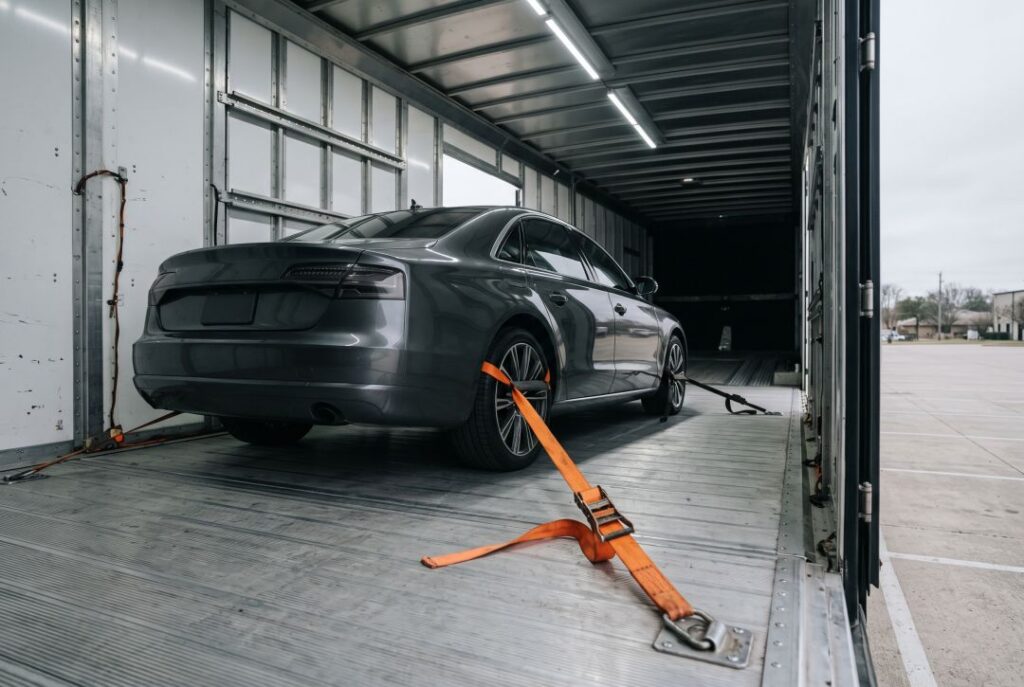
Door-to-door transport in Miami almost never means your literal door. A loaded car hauler runs around 75 feet and weighs up to 80,000 pounds, and most of Brickell, South Beach and the older residential grid cannot legally or physically accommodate one.
What you are actually buying is the closest safe, legal spot to your address. The auto transport companies worth booking tell you that before you pay. The ones to avoid promise your driveway and then call from a parking lot two miles away.
What door-to-door auto transport in Miami really means
Door-to-door vehicle delivery in Miami means the carrier picks up and delivers as close to your specified address as a full-size truck can safely and legally get. In dense neighborhoods that is frequently a meeting point rather than your driveway. Nearly every legitimate auto transport company operates this way, including the ones advertising it as a premium feature.
The difference between providers is not whether they reach your exact address. It is whether they warn you in advance, and whether the driver calls before he is already stuck.
That single distinction predicts most of the bad reviews in this industry. Whether a listing calls it door to door vehicle shipping or dresses it up as a premium tier, the physical constraint is the same for everyone.
Why Miami, FL is harder than most cities
Miami is a genuinely awkward market for vehicle shipping, and it has nothing to do with the companies.
Barrier island geography
South Beach and Miami Beach are reached by a handful of causeways. Streets are narrow, parking is metered or permit-only, and there is often nowhere to legally stage a truck for the fifteen to thirty minutes loading takes.Condo towers with no truck access
Brickell is the clearest example. Loading bays are sized for delivery vans and garage clearances typically run seven to eight feet. A car hauler cannot enter one, and building management usually has its own rules on top.Gated communities
Common across Miami-Dade and much of Hialeah. Many prohibit commercial vehicles above a certain length outright.Low-clearance and flood-prone streets
Parts of the older grid flood during king tides. Drivers will refuse a street they cannot get back out of.Seasonal volume swings
From October through December, snowbird traffic surges into Florida. New York, New York and Newark, New Jersey are two of the heaviest inbound lanes, along with Chicago, Illinois. Carrier capacity tightens and prices follow.
None of this makes Miami car shipping unreliable. It means the honest version of door-to-door has an asterisk, and you want a company that says the asterisk out loud.
Brokers versus auto transporters: check this first
Here is what most first-time shippers do not know, and it changes how you read every quote you get.
Most companies advertising Miami Auto Transport are brokers. They do not own trucks. They take your booking, then match it to a vetted carrier from a network of independent trucking companies. The truck that arrives has a different name on the door than the company you paid.
The FMCSA is blunt about this in its Consumer Advisory About Automobile Transporters: auto brokers only arrange transportation, and consumers should be suspicious of any website where it is not clear which one they are dealing with.
Read that twice. The problem is not brokerage. Brokerage is how nearly the entire industry works, and a good broker with a deep carrier network will find you a truck faster and at better rates than you could arrange alone. The problem is a company that talks about its own trucks and terminals when it has neither.
Both brokers and carriers operating across state lines must register with the FMCSA, and both are issued a six-digit MC docket number. Carriers also hold a seven-digit USDOT number. The advisory is specific: avoid any auto transporter or broker that does not prominently display its MC docket number.
How to verify a car shipping company in about two minutes
Find the MC number
Footer, contact page, or about page. If it is nowhere on the site, that is your answer.Pull the free Company Snapshot
Go to FMCSA SAFER and search by MC or USDOT number. No account needed.Confirm the status
Operating status should read active and the entity should be allowed to operate.Check the authority type
Broker authority and carrier authority are separate grants under FMCSA broker registration rules. This tells you who is physically moving your car.Read reviews for patterns
Cross-check the name against Better Business Bureau, ConsumerAffairs and Google. Look for repeated themes, not isolated complaints.
The better brokers assign dedicated transport coordinators, meaning one named person owns your booking from quote to delivery instead of a rotating call queue. It sounds minor. On a ten-day haul with a schedule change in the middle, it is the whole experience.
And if a shipping expert on the phone gets cagey when you ask which carrier will actually haul your car, you have learned something.
Car shipping companies you will encounter in Miami
Miami is one of the most competitive auto transport company markets in the country, so you will collect a lot of names fast. Sort them by what they structurally are, because that determines who is accountable when something goes wrong.
| Company | Structure | What to ask them |
|---|---|---|
| USA Auto Transport | Licensed property broker arranging transport through a vetted carrier network | Which carrier is assigned, and the realistic pickup point for your address |
| Nexus Auto Transport | Broker | Whether the quoted rate is binding or an estimate |
| Sherpa Auto Transport | Broker, markets a Price Lock Promise | Exactly what the price lock covers and what voids it |
| Navi Auto Transport | Broker | Carrier vetting standards and cargo coverage limits |
| SGT Auto Transport | Broker | Whether expedited and white-glove tiers are priced separately |
| AmeriFreight Auto Transport | Broker, markets a Damage-Free Guarantee | What the guarantee pays and what the deductible is |
| RoadRunner Auto Transport | Broker | Cancellation terms and how deposits are handled |
| A1 Auto Transport | Broker with a wide international footprint | Whether your lane is handled directly or through a partner |
| J&S Transportation | Regional operator | Which lanes they run on their own equipment |
| uShip | Open marketplace, carriers bid on your listing | Every bidder MC number, individually |
| Shiply | Open marketplace, carriers bid on your listing | The same, for every bid you receive |
A word on the marketplaces. uShip and Shiply can produce genuinely competitive rates because carriers bid against each other for your load. The tradeoff is that vetting becomes your job. You are the one running the SAFER lookup on each bidder. If you enjoy that, the savings are real. If not, a broker is doing that work and building the cost into the rate.
Watch how companies talk about tracking. GPS Tracking and live shipment tracking are advertised across the category and the quality varies enormously. Some providers genuinely stream truck position. Others mean a coordinator who calls you with updates. Both are fine. Being promised one and given the other is not. Ask which it is.
Same goes for an instant car shipping quote. An instant number from a calculator is a starting estimate built on averages. A quote from a person who has asked about access at your building, the condition of your vehicle and your date flexibility is a different product. Neither is dishonest, but the instant number is the one that tends to move later.
Open or enclosed transport
Two ways to move a car, and the choice is mostly about what the vehicle is worth to you.
| Open transport | Enclosed transport | |
|---|---|---|
| Vehicles per load | Up to 10 on a multi-level hauler | Up to 4 |
| Weather and road debris | Exposed | Fully protected |
| Loading | Ramps | Lift gate on most enclosed carriers, which matters for low-clearance cars |
| Availability | Very common, faster to book | Fewer trucks, longer lead time |
| Relative cost | Baseline | Typically 30% to 60% more |
| Best suited to | Daily drivers, standard sedans and SUVs | Luxury vehicle and high-value vehicles, exotics, modified cars, classic car shipping |
Open car shipping, sometimes called open-carrier shipping, is what roughly nine out of ten vehicles move on, and it is not a compromise. Your car is exposed to the same weather it would face parked outside. For most people that is the right call and the savings are substantial.
Enclosed auto transport earns its premium in two specific situations: when the car is worth enough that road debris is a real financial risk, and when ground clearance is low enough that ramps become a problem. The lift gate is the underrated part. Anyone who has watched a lowered car get dragged onto a ramp trailer understands why.
For a collector car, the deeper breakdown sits in enclosed transport for exotic and collector cars. You can compare the two side by side on the enclosed trailer and open trailer service pages.
What car shipping cost looks like on Miami lanes
Car shipping cost is driven by distance, vehicle size and weight, whether the car runs, how flexible your dates are, seasonal carrier demand, and fuel prices. Long routes cost more in total but less per mile.
For the highest-volume inbound Miami lane, published ranges run roughly $700 to $1,300 for open transport and $1,100 to $2,000 for enclosed on New York to Florida runs. The city-by-city breakdown is in the New York to Florida cost guide.
Booking during the October to December snowbird surge
Demand into Florida spikes and carrier capacity tightens.A hard pickup date instead of a window
Fewer trucks can accommodate it, so the rate climbs.An oversized truck or SUV, or a heavily modified vehicle
Weight and deck space both cost money.A non-running car requiring a winch
Inoperable vehicles need specific equipment and carry an additional fee.Barrier island delivery
Fewer carriers will accept a run onto Miami Beach or South Beach.
Working the other direction, these pull a Miami quote down:
A three or four day pickup window
Flexibility widens the pool of carriers who can take the job.Meeting the truck at an accessible location you choose
This is the single most effective lever available to you.Booking two or more weeks out
Last-minute loads pay a premium.Shipping in the slower late-spring months
Outside snowbird season, Florida lanes soften.
That second one deserves attention. Volunteering a nearby plaza instead of insisting on your building entrance can shave real money off a Miami quote, because it widens the pool of carriers willing to take the job. You are trading ten minutes of your time for a better rate and a faster match.
What fully insured actually covers
Every company in this category says fully insured. Very few explain the scope, so here is the part that matters.
Cargo coverage on a vehicle in transit protects against external damage: scratches, dents, and damage caused during loading, transit or unloading. Typical limits run up to $100,000 on open transport and up to $500,000 on enclosed transport, with insurance included in the rate rather than sold as an add-on.
What it does not cover is internal or mechanical failure. Brakes, engine, transmission, electrical faults. If your car arrives with a dead battery after eight days on a truck, that is not a cargo claim.
Ask for the certificate of insurance from the assigned carrier
Not just the broker assurance. Federal minimums exist, but actual cargo limits vary between trucking companies.Photograph everything before pickup
All four sides, roof, wheels, interior and odometer, with timestamps. This is your only real evidence if a claim comes up.
How vehicle pickup and delivery actually run
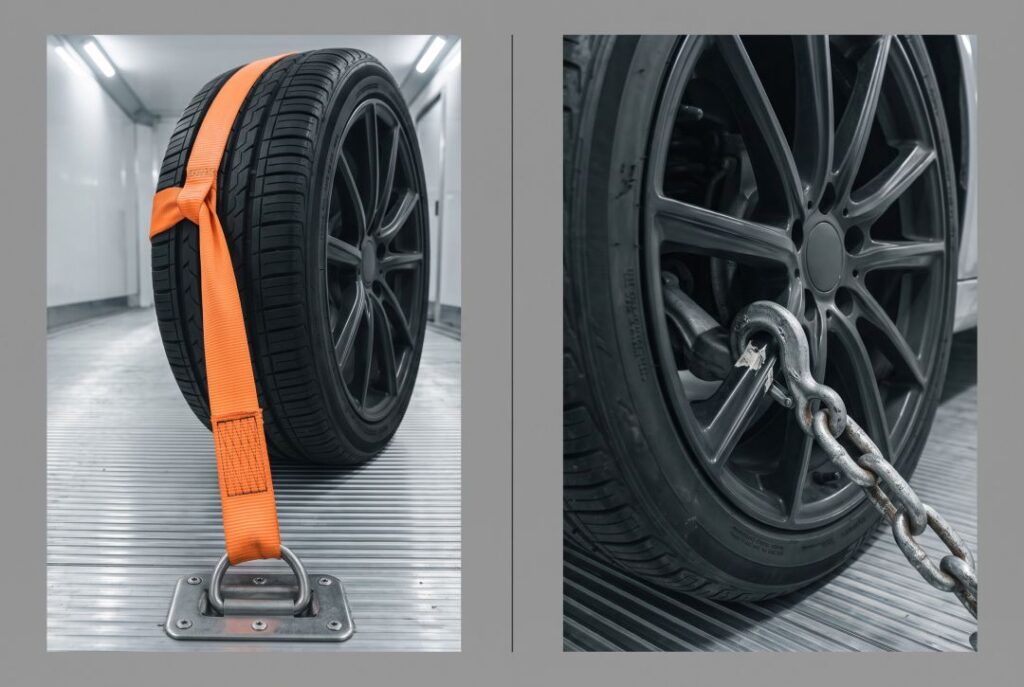
Booking. You provide origin and destination zip codes, the year, make and model, whether the car runs, and your date window. Quotes come by phone or through a request form. Anything that sounds final before someone has asked about access at your building is provisional.
Vehicle pickup. The driver calls ahead, usually the day before and again when he is close. Someone must be physically present. That person hands over a spare key and walks the vehicle with the driver during the pickup inspection, noting existing damage on the bill of lading. Both parties sign.
Fuel and belongings. Leave roughly an eighth to half a tank. Most companies allow up to 100 pounds of personal items in the trunk only, never the cabin. Carriers are not licensed to haul household goods, which is why that limit exists.
Transit. Typical guaranteed windows run 1 to 14 business days depending on mileage. Weather, traffic and road conditions extend it. On Miami inbound lanes, expect the longer end during snowbird season.
Vehicle delivery. The same drill in reverse. Someone must be present at the agreed pickup and delivery locations to receive the car and complete the final inspection against the bill of lading. Note any new damage before you sign. Signing a clean bill of lading and calling about a scratch the next day is a losing position.
Payment. Most brokers collect in full shortly before pickup, commonly one business day out, by credit or debit card. The FMCSA advisory specifically recommends monitoring those transactions closely. Cancellation terms vary, so ask where the free-cancellation cutoff sits and what the fee is after it.
If you are still deciding between delivery formats, the tradeoffs are laid out in door-to-door versus terminal-to-terminal car shipping. Terminal service is cheaper and slower, and it removes the street-access problem entirely, which in Miami is a bigger advantage than it sounds.
Special cases worth asking about
Inoperable vehicles
Shippable for an additional fee, with conditions. The car generally needs a working emergency brake, inflated tires and operable steering so it can be winched and positioned. Say it does not run when you book. Discovering it on site means the driver leaves.Motorcycle relocation
Common, usually crated or strapped to specialized equipment. Not every carrier handles bikes, so confirm before booking rather than after.ATV and powersports
Some carriers handle them, some do not. Ask specifically, and tie the answer to your assigned carrier rather than the company in general.International shipping
The Port of Miami is one of the largest vehicle export gateways in the United States. Companies handling international shipping run the domestic leg to the port separately from the ocean freight, so confirm which legs your provider actually performs. The same applies to Alaska service, where runs to Anchorage and Fairbanks are typically barge legs with a domestic haul on either end.Other Florida markets
Most companies covering Miami also run Fort Lauderdale, Orlando, Tampa and Jacksonville. Bundling a pickup in one and a delivery in another is often cheaper than two separate bookings.
Red flags when comparing car shipping companies
No MC docket number anywhere on the site
FMCSA names this as the single clearest warning sign.A quote dramatically below everyone else
The load usually sits undispatched until the price is revised upward.A large deposit demanded before a carrier is assigned
You are paying for something that has not been arranged yet.Refusal to name the assigned trucking company
A legitimate broker will tell you who is hauling your car.Promises of an exact pickup hour on a long-haul lane
No one can honestly guarantee this across several states.Marketing that describes owned trucks and terminals from a registered broker
This is the mismatch the FMCSA advisory is built around.Pressure to sign the bill of lading without walking the vehicle
The inspection is the whole point of that document.
Frequently asked questions
- Does door-to-door auto transport in Miami mean the truck comes to my exact address?
- Usually not, and no reputable company can promise it. Door-to-door means the closest safe, legal point to your address that a roughly 75-foot car hauler can reach. In Brickell, South Beach and gated communities, that is typically a nearby wide street or shopping plaza. Suburban Miami-Dade addresses often do get true curbside service.
- How long does it take to ship a car to or from Miami?
- Most guaranteed windows run 1 to 14 business days depending on mileage. Short Florida routes land at the low end and cross-country runs from California sit near the top. Weather, traffic and carrier routing can extend any of it, and snowbird season from October through December adds pressure on Florida inbound lanes.
- Is enclosed car shipping worth the extra cost in Florida?
- It depends on the vehicle. Enclosed transport typically costs 30% to 60% more. That premium makes sense for collector cars, exotics, low-clearance vehicles that need a lift gate, and anything where paint damage would be expensive to correct. For a standard daily driver, open transport is the sensible choice.
- How do I check whether a Miami auto transport company is legitimate?
- Find the MC docket number, then look the company up free on the FMCSA SAFER Company Snapshot. Confirm the authority is active and the company is allowed to operate. Check whether it holds broker or carrier authority, since that tells you who is physically moving your car. Then read reviews across Better Business Bureau, ConsumerAffairs and Google for patterns.
Where to go from here
Shipping a car is not complicated. It has a handful of details that decide whether the experience is smooth or irritating, and almost all of them get settled in the first phone call.
Ask where the truck will actually stop. Ask for the MC number. Ask what the insurance covers. If the answers are specific, you are probably dealing with someone competent.
For Miami-specific routing and coverage, see Miami auto transport, or review the open or enclosed transport options before requesting a quote.